
 Home
Home About
About Tours
Tours Bikes Rental
 Contact
Ha Giang Loop photography tips can make the difference between ordinary snapshots and truly breathtaking images from one of Southeast Asia’s most dramatic landscapes. Stretching 300km through Vietnam’s far north, the Ha Giang Loop winds past UNESCO-listed karst plateaus, thousand-meter river gorges, and living ethnic minority villages a photographer’s landscape that rewards preparation above all else.
Knowing which pass to reach before sunrise, which lens to carry for terrace compression, and how to navigate drone restrictions near the Chinese border separates photographers who come home with portfolio-defining work from those who return with tourist photos and before any of that, getting your gear and supplies right starts with a thorough Ha Giang loop packing list that accounts for the route’s remote conditions and rapidly shifting mountain weather
Whether you shoot on a mirrorless camera, a drone, or a smartphone, this complete guide to Ha Giang Loop photography covers every location, every technique, and every timing decision you need so your frames do justice to one of the world’s great road photography routes.
What Makes Ha Giang Loop a World-Class Photography Destination?
- Landscape photography: Jagged limestone karst formations rising above 1,600 meters, river gorges exceeding 1,000 meters in depth, and terraced fields that ripple across mountainsides in geometric patterns visible from kilometers away — all accessible directly from the road without multi-day trekking.
- Cultural and portrait photography: Direct access to 19 ethnic minority groups — Hmong, Tay, Dao, Lo Lo, and others — whose weekly markets, weaving villages, and daily routines provide an inexhaustible source of human storytelling that no other Vietnam photography route concentrates in a single circuit.
- Road and architecture photography: Iconic engineered roads like Ma Pi Leng Pass and Tham Ma Pass, where switchbacks carved into sheer cliff faces create aerial geometry that defines the region’s visual identity and produces images instantly recognizable as Ha Giang.
- Aerial and drone photography: Valley floors, patchwork terraces, and river bends that reveal their full drama only from altitude — the Nho Que River’s emerald color against grey karst walls, the S-curve geometry of Tham Ma Pass from above, the patchwork terrace floors of Hoang Su Phi.
TOP 15 Best Photography Spots on the Ha Giang Loop
Below is a detailed breakdown of each location with composition strategies, optimal timing, and practical logistics, starting with the five landmark subjects that define the loop’s visual identity.
1. Ma Pi Leng Pass & Tu San Canyon
The classic shot is taken from one of several pull-off points along the pass midpoint: looking back along the cliff-hugging road with the limestone face rising on one side and the turquoise Nho Que River far below on the other. Early morning (6:30–8:00 AM) regularly produces mist rising off the river while the road itself sits in clean directional light — a combination that creates natural atmospheric depth without any post-processing.Late afternoon (4:30–6:00 PM) delivers side-lit karst faces and long shadows across the switchbacks, producing a harder, more dramatic palette.
For alternative angles, the Ma Pi Leng Skywalk — a steel platform extending from the cliff face — offers a more secluded perspective away from the main viewpoint crowd. The “Death Rock,” a free-standing outcropping requiring a brief scramble, provides a top-down view of the canyon that emphasizes scale at the cost of some personal risk. For drone pilots, launching from the pull-off areas (never over active road traffic) and flying south toward the canyon mouth produces aerial shots of the Nho Que’s emerald color against the grey karst walls that no ground-level image can replicate. Critical safety note: maintain strict eastern flight paths to avoid the Chinese border restriction zone.
Composition technique: include a motorbike or single rider at a pull-off to give the cliffs their true scale if you have not yet sorted your vehicle, arranging Ha Giang motorbike rental before arriving at the pass gives you the flexibility to stop freely at any pull-off without time pressure from a shared schedule. Without a human element in the frame, even experienced viewers underestimate the vertical relief of the canyon walls.
Use the road as a leading line from lower-left to upper-right of the frame this winding geometry is the visual signature of Ma Pi Leng and what makes the location instantly recognizable.
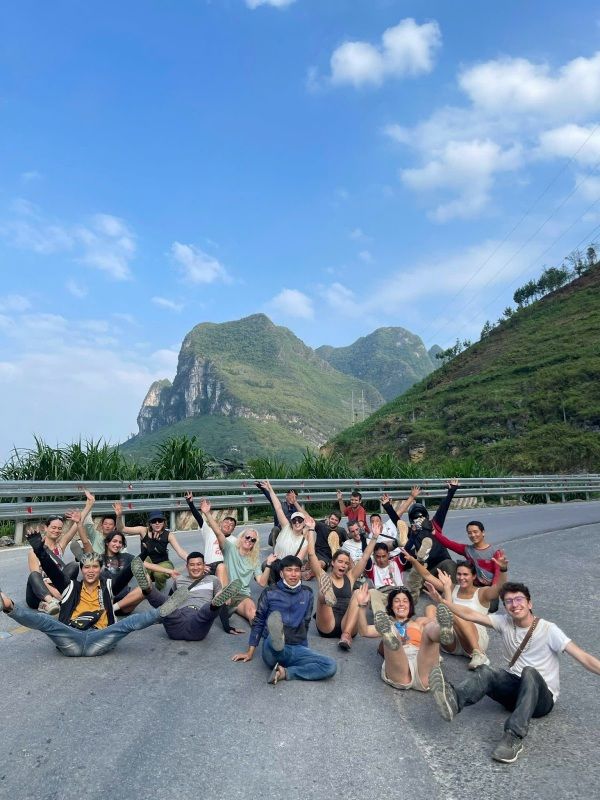
2. Quan Ba Heaven Gate & Twin Mountains
Quan Ba Heaven Gate is the first major viewpoint on the Ha Giang Loop, sitting at approximately 1,500 meters elevation and looking down over the Tam Son Valley, where two perfectly symmetrical rounded limestone peaks locally called “Fairy Bosom” or Núi Đôi — create a focal point unlike anything else in northern Vietnam.
Best shooting time is early morning from 6:30 to 8:00 AM, when mist fills the valley and the twin peaks emerge above the fog layer a scene that communicates the “heavenly gate” name visually without any caption. Late afternoon from 4:00 to 5:30 PM delivers warm golden illumination on the terrace fields that surround the peaks. The main viewpoint has a dedicated parking area and fills quickly; walking 100 meters north along the road reveals alternative angles that eliminate other tourists from the frame entirely.
Seasonally, September–October turns the surrounding rice terraces gold, creating a warmer compositional palette. October–November adds buckwheat flowers on nearby hillsides, shifting the foreground color from green and gold to pink and white. Use a wide-angle lens (16–24mm) or the ultra-wide mode on a smartphone to capture both the full valley sweep and the twin mountains in a single frame. Drone photography from the parking area flying out over the valley, not over road traffic reveals the twin peaks’ symmetry from above in a way that emphasizes their geological improbability.
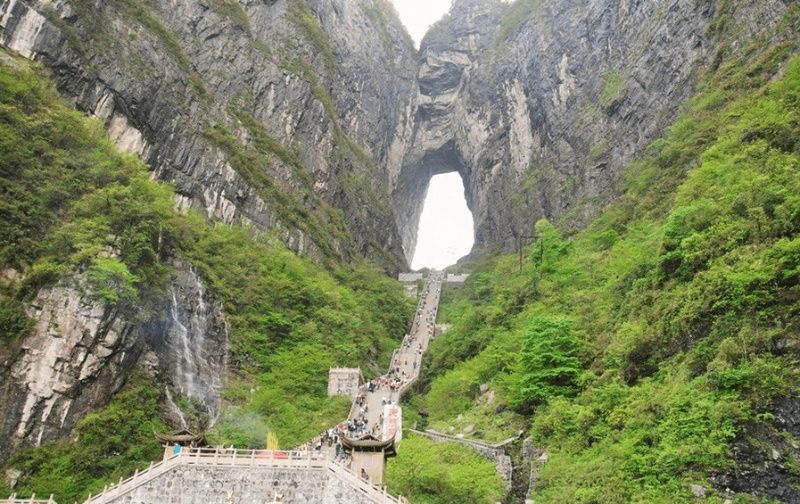
3. Tham Ma Pass
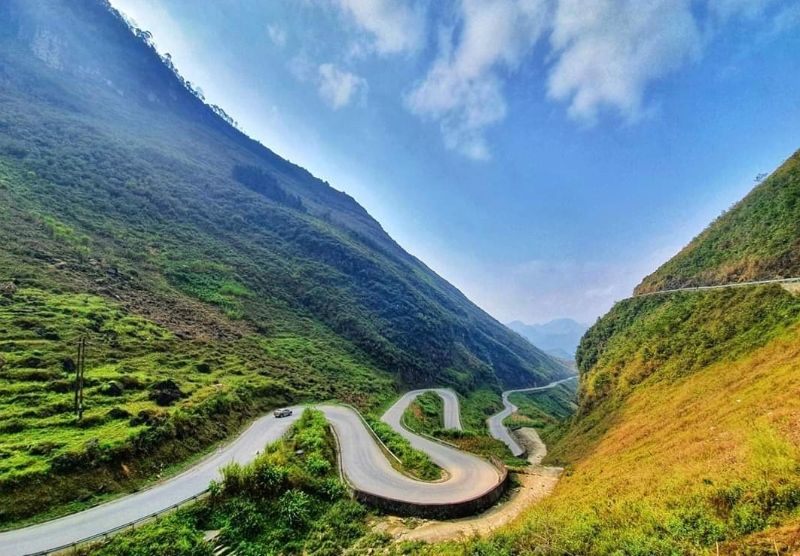
Tham Ma Pass is a legendary “S”-shaped road with nine dramatic hairpin bends snaking through massive limestone cliffs the most photographed road pattern on the entire loop and the defining symbol of Ha Giang’s engineered mountain infrastructure.
The most popular angle is from the rock outcropping at the summit, looking directly down at the ribbon-like road as it zigzags up the limestone slope. This top-down perspective particularly powerful from a drone for its spiral geometry makes the engineering achievement legible in a single frame. The best shooting time is 9:00–10:30 AM mid-morning, when the sun is high enough to clear the cliff walls but not yet directly overhead, producing clear definition on each curve without blown-out shadows. Parking is easy at the wide gravel area at the top of the pass.
For a more culturally layered composition, frame the S-curve in the distance with the colorful flower baskets of local Hmong children in the foreground this creates a juxtaposition between the grandeur of the landscape and the intimate human activity that gives the image editorial depth. Use a wide-angle lens to exaggerate the curvature of the road against the cliff background; adding a friend or fellow traveler at the nearest bend provides immediate human scale.
4. Lung Cu Flag Tower
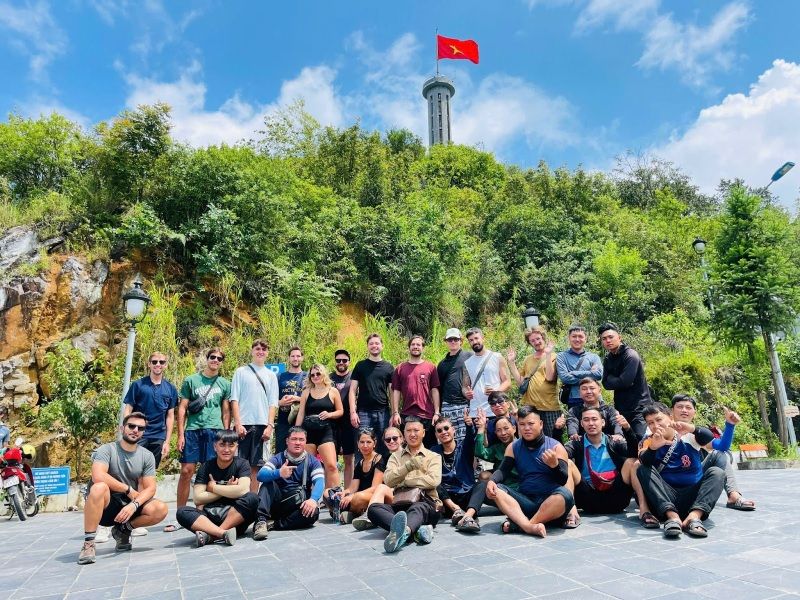
Lung Cu Flag Tower is a 30-meter flagpole marking Vietnam’s northernmost point, located just 2 kilometers from the Chinese border and perched on a hill above the Lo Lo Chai ethnic village — offering 360-degree panoramic views of rolling highland terrain that carries a distinct atmosphere of geopolitical frontier.
Best shooting time is sunrise or early morning, when clouds drift around the surrounding mountain peaks and the flagpole catches the first directional light. Climb the tower for the full 360-degree panorama; frame the flagpole against rolling hills with Lung Cam village visible below for contextual depth. In buckwheat season (October–November), the hillsides near Lung Cu are covered in pink-white blossoms, adding foreground color that transforms what could be a simple landmark shot into a seasonal landscape.
Drone caution is critical here. The proximity to the Chinese border creates genuine restriction zones. Keep all flight paths strictly eastward, away from the border direction; exercise maximum discretion and check current local guidance before launching. If authorities ask you to land, comply immediately without discussion. After the tower, walk down into Lo Lo Chai village for close-range cultural photography of traditional stone and mud-walled houses, courtyards, and daily life — subjects that provide a human counterpoint to the symbolic scale of the flagpole.
5. Dong Van Old Quarter & Meo Vac Sunday Market
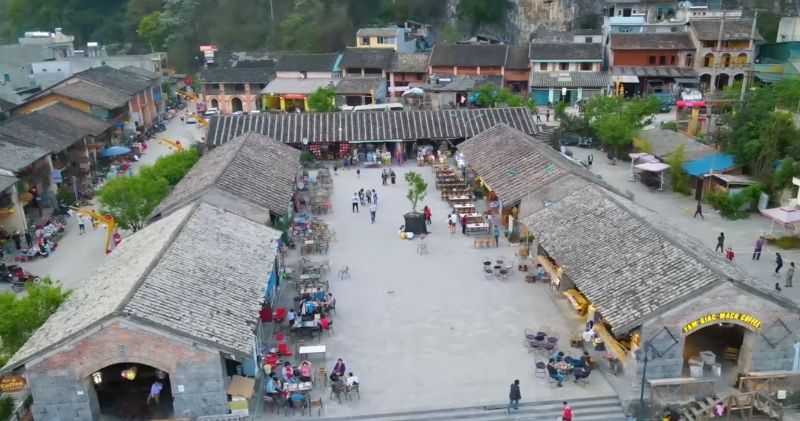
Dong Van Old Quarter and Meo Vac Sunday Market are the two premier cultural photography subjects on the Ha Giang Loop the Old Quarter for its preserved stone-and-clay architecture under golden-hour light, and the Sunday market for its concentrated gathering of multiple ethnic groups in traditional dress.
The Old Quarter’s stone houses, yellow-plastered walls, and red lanterns create a warm, layered backdrop that performs best under late afternoon golden-hour light (4:30–6:00 PM), when horizontal sunlight rakes across the textured walls and brings out their ochre and terracotta tones. The Saturday night market and Sunday morning activity add moving subjects — food stalls, textile traders, and local residents — to what is otherwise an architectural subject. Use a low aperture (f/1.8–f/2.0) for shallow-depth-of-field street portraits with the Old Quarter architecture softened behind your subject.
Every Sunday, Meo Vac Square and the surrounding streets fill with Hmong, Dao, Tay, and other ethnic traders in full traditional dress — a concentrated visual palette of indigo textiles, embroidered shawls, and silver jewelry set against the earthy mountain backdrop. Photographers joining a Ha Giang motorbike tour with a local guide gain a practical advantage here: guides know which village groups arrive earliest and can position you at the market before the light and the crowd shift.
Arrive before 8:00 AM to find the market in its most active, pre-tourist state. Shoot from eye-level or lower for portraits that give subjects dignity and visual presence against the dramatic limestone mountains behind them. Always ask permission — a smile and “Chụp ảnh được không?” (May I photograph you?) before shooting portraits is non-negotiable and consistently produces more genuine expressions than candid approaches. Drone photography is not appropriate in the market area; keep camera activity at ground level and respectful.
6. Hoang Su Phi Rice Terraces
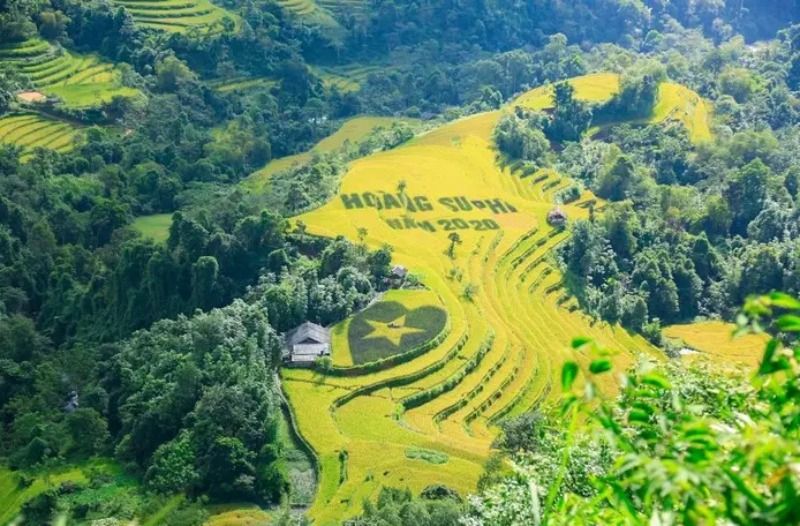
Hoang Su Phi is Ha Giang’s most extensive rice terrace system, with layered agricultural terraces spreading across mountainsides through Ban Phung, San Xa Ho, and Thon Chu Phin — producing the most visually complex terrace photography on the loop and one of the most celebrated landscape subjects in all of northern Vietnam.
The terraces reach their seasonal peak twice: September–October for golden harvest light when heavy grain bends the stalks and the fields glow amber, and May–June for the water-flooded planting season when each terrace mirrors the sky like a stepped pool. For ground-based photographers, a telephoto lens (70–200mm) compresses the terrace layers into stacked abstract bands of color — a technique that eliminates the sky entirely and transforms agricultural geography into near-abstract visual texture. For broader context, find a high ridge above the village clusters and use a wide-angle to show the full scope of the terracing against the mountain horizon.
Drone pilots should plan flights for the moment the sun dips behind the western peaks — typically 5:00–6:00 PM — when shadows fill the contours between terrace walls and the remaining light skims the surface at a low angle, making the carved steps read as three-dimensional sculpture from above. Start the drone focused on the nearest village cluster, then ascend and pan outward to reveal the full extent of the terracing — a cinematic reveal that communicates the true scale of the human agricultural effort embedded in this landscape.
Remaining 9 Locations at a Glance
| Location | Best Shot | Best Time | Lens | Drone |
|---|---|---|---|---|
| 7. Nho Que River boat ride | Vertical cliffs rising from river level; low-angle wide frame from bow of boat | 7:00–9:00 AM, calm water | 16–24mm | No (water/logistics) |
| 8. Sung La Valley | Limestone spires above Hmong village; portrait of local against rock forest backdrop | 8:00–10:00 AM side light | 50mm / 85mm | Yes (open valley) |
| 9. Pho Bang terraced fields | Concentric terrace rows hugging hillside; backlit gentle light on curved contours | Sunrise 6:00–7:30 AM | 24–70mm | Yes (open ridge) |
| 10. Du Gia waterfall | Slow-shutter milky water from tripod; overhead drone perspective through tree canopy | Morning before 3 PM crowd | 16–35mm + tripod | Limited (tree cover) |
| 11. Thach Son Than limestone pillars | Vertical stone columns above buckwheat fields; flowers in foreground, pillars behind | Oct–Nov flower season | 50–100mm | Yes (open field) |
| 12. Nam Dan village rock forest | Environmental portrait with limestone “rock forest” backdrop; fill flash if overcast | 8:00–11:00 AM | 50mm / 85mm | Caution (village) |
| 13. Lung Cam stilt village | Dawn mist pastoral; stilt houses emerging from valley fog | 6:00–7:30 AM sunrise | 24–70mm | Yes (open valley) |
| 14. Dong Van Karst Plateau | Grey limestone field textures at golden hour; ethnic hamlets as scale markers | 5:00–6:30 PM golden hour | 16–24mm wide | Yes (open plateau) |
| 15. Yen Minh valley scenes | Lush green valley between Dong Van and Yen Minh; roadside village life | 7:00–9:00 AM morning activity | 24–70mm | Yes (open terrain) |
When Is the Best Time to Photograph the Ha Giang Loop?
Ha Giang Loop photography divides across four seasonal windows, each producing a substantially different visual palette that suits different photographic styles and subject priorities.
- October–December: The Peak Photography Window. Late October sits at the intersection of two major seasonal events: the buckwheat flower bloom (October–November) coats hillsides near Lung Cu, Dong Van, and Thach Son Than in pink-white blossoms, while September–October golden rice terraces in Hoang Su Phi and Yen Minh are still visible early in this window. Clear skies and maximum visibility from high passes like Ma Pi Leng produce the sharpest long-distance landscape images of the year. November–December brings cooler temperatures and increasingly barren limestone that creates a starker, more graphic visual aesthetic on the karst plateau.
- September–October: Golden Harvest. The rice harvest transforms terrace systems into sheets of amber and gold, particularly in Hoang Su Phi. Weather remains warm and manageable, and while September can have residual rain from the wet season, October delivers reliable conditions. This is the window most landscape photographers specifically target for terrace photography.
- March–May: Spring Blossoms and Cultural Activity. Wildflowers bloom across the highlands, fresh green covers the karst hillsides, and local festivals return after the winter quiet producing the highest concentration of cultural photography opportunities. For photographers planning their departure timeline, our guide to the Ha Giang loop from Hanoi covers transport options, arrival windows, and how to align your travel day with the seasonal conditions most relevant to your shooting goals.. Cherry blossoms appear in some highland areas in late February and March. The light is warm and comfortable without the harsh summer intensity.
- June–August (Rainy Season): Atmospheric and Unpredictable. This window is not a photographic failure — it is a different photographic language. Rice terraces are flooded and intensely green, waterfalls that barely exist in dry season roar to full volume, and mist pours through gorges in dramatic volumes. The tradeoff is unpredictable cloud cover, slippery roads, and shooting days where the mist simply never lifts. For photographers who want moody, editorial, atmospheric images rather than the classic postcard aesthetic, May through early June and September offer genuinely rewarding conditions that most Ha Giang photography does not represent.
Four Focal Length Ranges Cover Every Photography Style Available on the Loop
- Wide-angle (16–24mm): The essential lens for the loop. Mountain passes, valley panoramas, the road ribbon effect at Tham Ma Pass, the full sweep of Heaven Gate — all require a wide field of view to convey scale. Without a wide-angle, even physically standing at the right location produces images that compress the depth and make mountains appear smaller than they are in person. On a full-frame camera, the 16–35mm f/2.8 is the single most versatile choice for this route; on a crop-sensor body, a 10–18mm equivalent delivers the same effective coverage.
- Standard to short telephoto (50mm and 85mm): The portrait lens pair for ethnic minority communities. At 50mm, an environmental portrait includes enough background to communicate setting while beginning to separate the subject from it. At 85mm, the separation is more pronounced — a Hmong woman at a market stall, her embroidered shawl in sharp focus, the stone houses behind softened to color shapes rather than distracting detail. An f/1.8 aperture on either focal length is sufficient for the shallow depth of field and light-gathering needed in market and village shooting conditions.
- Telephoto (70–200mm): Primarily used for rice terrace compression and candid market photography from a respectful distance. At 200mm from a ridge above Hoang Su Phi, individual terrace layers stack into a near-abstract pattern of parallel curves — a compositional effect impossible at wide angles.
- Specialist items: A neutral density (ND) filter is essential for smooth waterfall shots at Du Gia and for managing highlight exposure during bright highland midday. A sturdy tripod serves double duty: pre-dawn viewpoint work where handheld shooting introduces motion blur, and long-exposure astrophotography from high-elevation villages on clear dry-season nights. Photographers who want route logistics handled so they can focus entirely on shooting can find itinerary and vehicle options through Vietmotorbiketour, where local expertise on timing and access points is built into the service.”