
 Home
Home About
About Tours
Tours Bikes Rental
 Contact
Every autumn, the mountains of Ha Giang transform into something that stops travelers mid-breath terraced rice fields rolling across steep hillsides in waves of gold, green, and mirror-silver, carved by hand over centuries by ethnic minority communities who still farm them today. For riders exploring the famous Ha Giang Loop with Viet Motorbike Tour, these landscapes are not a detour they are a destination in their own right.
The best rice fields in Ha Giang are spread across six distinct locations, each with its own visual character, peak season, and cultural story. From the nationally recognized heritage terraces of Hoang Su Phi to the remote jungle valley of Du Gia and the bamboo-irrigated fields of Quang Binh commune, no two locations offer the same experience.
This guide covers all six, tells you exactly when to visit each one, and helps you build a motorbike itinerary around Ha Giang’s most breathtaking rice field landscapes.
Why Is Ha Giang Famous for Terraced Rice Fields ?
Ha Giang has earned its reputation as home to some of Vietnam’s most spectacular terraced rice fields and the reasons go far beyond simple aesthetics. Here’s what sets this remote northern province apart:
- Extreme terrain forced extraordinary engineering. Ha Giang sits at Vietnam’s northernmost tip, where jagged limestone peaks, deep river gorges, and near-vertical hillsides left farmers with almost no flat land. Terrace farming wasn’t a stylistic choice — it was a matter of survival, and the result is an agricultural system of remarkable scale and ingenuity.
- The water system is entirely gravity-driven. Each terrace acts as a miniature reservoir, holding just enough moisture for a rice crop while channeling surplus water downhill to the next level. This chain of interconnected water management — built by ethnic minority communities without modern tools or concrete — covers tens of thousands of hectares across the province’s western and central districts.
- A single harvest amplifies the visual spectacle. Unlike lowland Vietnam, where warmer conditions allow two or three rice cycles per year, Ha Giang’s elevation limits farmers to one annual harvest. This means the entire landscape transforms together — from flooded mirrors in spring to vivid green in summer to a blazing gold in autumn — concentrating the most photogenic moments into just a few weeks.
- The scale is simply unmatched. Because terrace farming was the only viable agricultural method across such a vast, mountainous area, the systems here grew larger and more intricate than in many other parts of Vietnam. Entire mountain faces — from valley floor to cloud-wrapped ridgeline — are carved into hundreds of stacked levels.
Indigenous communities shaped every contour. Much of what visitors see today was built and maintained over generations by the H’Mong, Dao, Tay, and other ethnic minority groups who still live and farm here. The terraces are as much a cultural landscape as a natural one.
Which Ethnic Minority Communities Create and Maintain These Rice Fields?
Ha Giang’s terraced rice fields are the living creation of at least 12 ethnic minority groups, including the Dao, Hmong, Nung, La Chi, Tay, and Phu La peoples, each of whom has developed distinct farming traditions, irrigation techniques, and seasonal rituals tied to the rice growing cycle.
These communities did not simply build fields they built entire ways of life around them. The Dao people of Ban Luoc and Nam Hong are known for their intricate water-management systems that direct mountain spring water through bamboo channels to flood terraces at precisely the right moment in the planting cycle. The La Chi community of Ban Phung took the relationship between settlement and farmland to an unusual extreme: they built their homes directly inside the terrace fields rather than on separate elevated ground, creating a landscape where human habitation and agriculture are inseparable. The Hmong communities further north, around the Dong Van Karst Plateau, adapted terrace farming to even higher and drier elevations, integrating corn and buckwheat cultivation alongside rice in a mosaic of crops that gives Sung La Valley its distinctive multi-textured appearance in September and October. For travelers, understanding which community manages which landscape adds a layer of meaning that transforms the experience from passive sightseeing into genuine cultural encounter.
Top 6 Best Terraced Rice Fields to Visit in Ha Giang
There are 6 best terraced rice field destinations in Ha Giang: Hoang Su Phi, Ban Phung, Ban Luoc, Quang Binh Commune in Xin Man district, Du Gia, and Sung La Valley each distinguished by a different visual character, best season, and type of travel experience it offers.
1. Hoang Su Phi
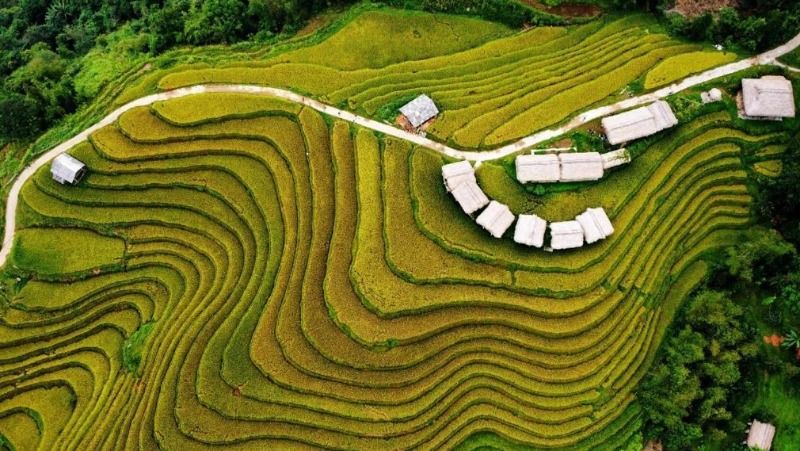
Hoang Su Phi is the standout destination for terraced rice fields in Ha Giang and for good reason. The district holds the province’s largest terrace system, a national heritage designation, and the most established infrastructure for travelers, from trekking routes to family-run homestays. The terraces spread across six communes, with Ban Phung, Ban Luoc, and Nam Ty being the most celebrated. Because each commune follows a slightly different planting schedule, visitors who spend two or more days here can see terraces at multiple stages at once some still green, others already turning gold extending the best viewing window well beyond a single weekend. For the most sweeping perspective over the entire landscape, the Cong Troi (Heaven’s Gate) viewpoint on Provincial Road 177 is unmissable, especially at dawn when morning mist drifts between the terrace tiers. Plan for at least two days; three to four is ideal.
2. Ban Phung
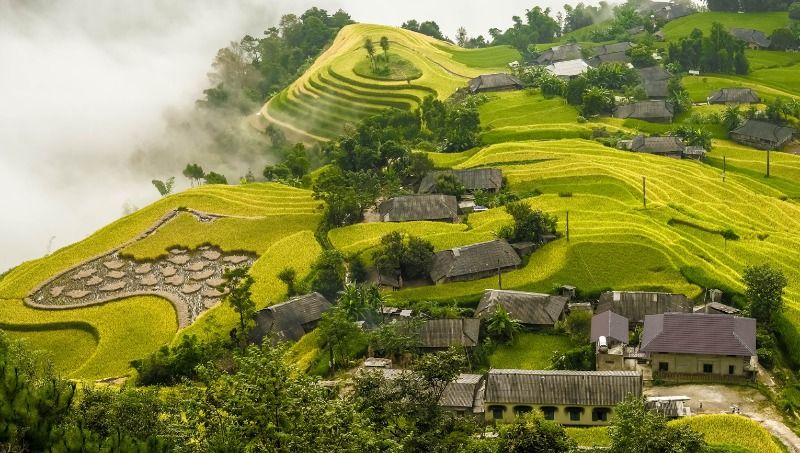
Ban Phung delivers one of the most immersive rice field experiences in all of Ha Giang. Draped across the steep flanks of the Tay Con Linh mountain range, its roughly 120 hectares of terraces are carved more densely than almost anywhere else in the province — the extreme gradients forced farmers to stack more tiers into a shorter vertical drop, creating a compressed, visually intense landscape that hits differently than gentler terrace systems. When rice ripens in September, the fields roll into sweeping waves of gold that follow the mountain’s natural curves rather than cutting straight across them. What truly sets Ban Phung apart, though, is how the La Chi community built their wooden homes directly inside the terrace fields. Walking through during harvest season means moving between rows of ripening rice with farmhouses appearing unexpectedly in the middle of the fields, smoke drifting from cooking fires, and farmers working just steps away. Ban Phung is about 15 kilometers south of Hoang Su Phi district center, reachable by motorbike on a paved road.
3. Ban Luoc
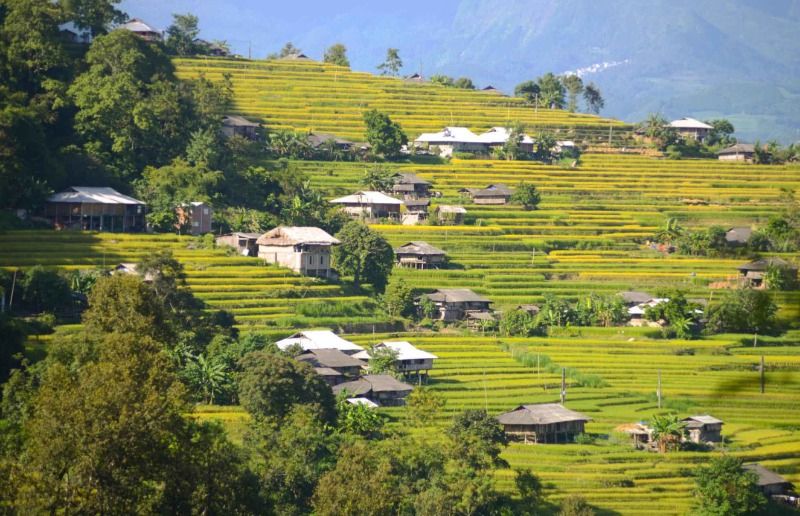
Ban Luoc is widely regarded as one of Ha Giang’s finest photography locations — and once you see it, the reason is obvious. Spanning 160 hectares of steeply carved terraces, the commune’s particularly rugged terrain forced farmers to make more horizontal cuts per vertical meter than in gentler systems, resulting in taller, more visually prominent terrace walls that slice across the hillside in sharp, dramatic lines. What elevates Ban Luoc beyond a purely agricultural landscape is the presence of traditional Tay and Dao stilt houses positioned at mid-terrace level, providing natural foreground elements and a sense of human scale that makes compositions feel alive rather than empty. During September and October, the golden harvest tones play against dark forest patches and the warm timber of the stilt houses — a color palette that holds up in virtually any lighting condition, from flat overcast to golden hour. Ban Luoc sits within the core zone of the Hoang Su Phi National Scenic Relic, roughly 15 kilometers south of the district center, and is most rewarding when combined with Ban Phung on a two-day circuit.
4. Quang Binh Commune, Xin Man
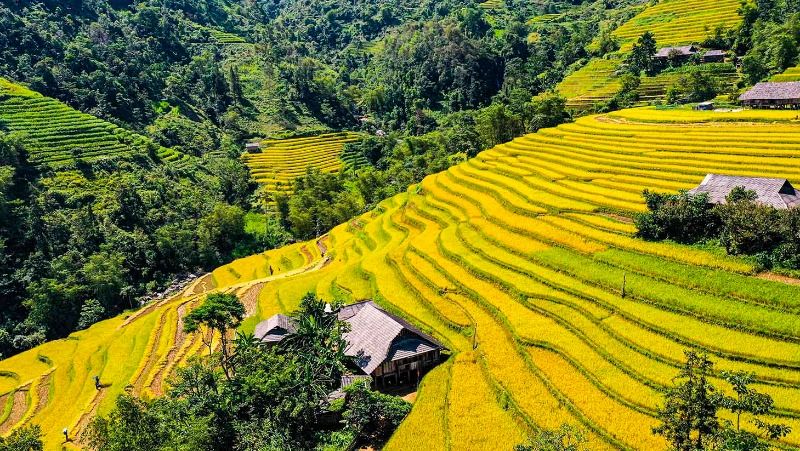
Quang Binh offers something no other rice field destination in Ha Giang — or Vietnam — can match: a centuries-old bamboo-tube irrigation system that turns the act of watering a field into a spectacle in its own right. Communities here have long used interlocking sections of cut bamboo, carefully angled across the hillside, to carry water from high-altitude springs down through every terrace level without waste — a living hydraulic network that is as impressive to watch in motion as the fields themselves. Unlike most of Ha Giang’s terrace destinations, where the draw is the September and October harvest, Quang Binh peaks from May to June during the water-pouring phase, when farmers coordinate the flow across the entire system simultaneously. For travelers who cannot make the autumn window — or who have already done Hoang Su Phi and want a genuinely different experience this is an exceptional alternative. Quang Binh sits in Xin Man district, roughly 100 kilometers from Ha Giang city, and pairs well with other western province destinations on a longer itinerary.
5. Du Gia Rice Fields
Du Gia, located in Bac Me district, sits within a jungle valley setting that combines rice terraces with river scenery in a way that feels fundamentally different from the high-altitude mountain terraces of Hoang Su Phi. The remoteness that keeps Du Gia off most standard itineraries is precisely what makes it rewarding the fields here retain a wildness and organic irregularity that more visited areas have lost as tourism infrastructure has grown. Du Gia works especially well as a destination for travelers combining trekking with rice field scenery, as the surrounding forest provides multi-day trekking routes that pass through terrace landscapes at different elevations.
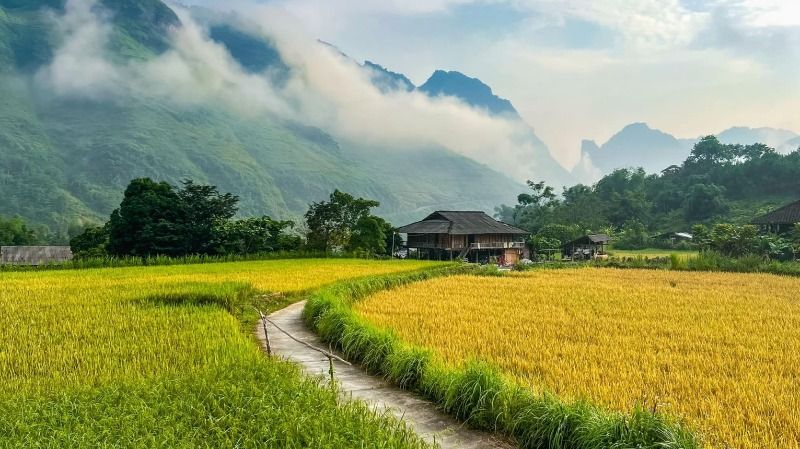
6. Sung La Valley Rice Fields
Sung La Valley, located within the Dong Van Karst Plateau area, offers a compositionally different landscape: here, rice terraces share the hillsides with buckwheat flower meadows and corn fields, creating a three-texture mosaic in September and October that ranges from deep green to golden yellow to the pale pink of buckwheat blossoms. For travelers riding the Ha Giang Loop — the most popular motorbike route through the province — Sung La sits naturally along the circuit and requires no significant detour. The valley is also known for appearing in Vietnamese cinema and photography, which gives it a cultural resonance that extends beyond its natural beauty.
The Best Time to Visit Rice Fields in Ha Giang
Ha Giang’s terraced rice fields offer 4 distinct visual seasons throughout the year: the water-pouring season (April–May), the green growth season (June–August), the harvest season (September–October), and the off-season (November–March) — each delivering a genuinely different landscape, atmosphere, and set of travel experiences.
The table below maps each seasonal phase to its key visual characteristics, recommended activities, and ideal traveler profile providing a quick reference before the detailed seasonal descriptions that follow.
| Season | Months | Visual Character | Best Activity | Crowd Level |
|---|---|---|---|---|
| Water-Pouring | April–May | Flooded terraces mirror sky | Photography, cultural observation | Moderate |
| Green Growth | June–August | Vivid emerald terraces | Trekking, homestay | Low |
| Harvest | September–October | Golden-yellow ripened rice | Photography, cultural immersion | High |
| Off-Season | November–March | Fallow fields, mist, festivals | Cultural festivals, quiet exploration |
What Do Ha Giang’s Rice Fields Look Like in Each Season?
Ha Giang’s terraced rice fields look completely different depending on when you visit — and each season offers a genuinely distinct experience worth considering on its own terms.
- April to May — Water-Pouring Season. Farmers flood the terraces ahead of planting, transforming entire hillsides into tiered mirrors that reflect the sky, clouds, and surrounding peaks. The effect is most striking in the early morning before wind breaks the water surface, and on overcast days when diffused light saturates the blue-grey tones across every level. This season draws far fewer visitors than harvest, making it one of the best-kept windows in Ha Giang’s travel calendar.
- June to August — Green Growth Season. Young rice plants push through in vivid emerald green, covering the terraces in saturated color from valley floor to ridgeline. Tourism is at its quietest during these months, which means more space on the trails, more availability at homestays, and more genuine interaction with local families who aren’t stretched by peak-season demand. The cooler mountain air also makes multi-day trekking between villages genuinely comfortable.
- September to October — Harvest Season. This is the moment Ha Giang is most famous for. As rice ripens, the terraces shift from green-gold to a deep, saturated yellow that seems to glow from within — particularly in the late afternoon light. Farmers in traditional clothing cut and bundle rice by hand across the hillsides, adding human warmth to an already extraordinary landscape. Accommodation in Hoang Su Phi books out weeks in advance; plan early.
- November to March — Off-Season. After harvest, the terraces lie fallow — dark earth, crop stubble, and morning mist rolling through the valleys for days at a time. It is a slower, more contemplative Ha Giang, and one that rewards patient travelers. January through March also brings Hmong New Year celebrations and Dao spring festivals, offering cultural experiences that the noise and crowds of peak season can easily overshadow.
Above are the 6 most breathtaking terraced rice fields in Ha Giang from the nationally recognized heritage landscape of Hoang Su Phi to the hidden bamboo-irrigated terraces of Quang Binh commune and the golden mosaic of Sung La Valley. Each location offers something the others cannot, and the right time to visit each one makes all the difference between a good trip and an unforgettable one.
Whether you are chasing the golden harvest in September, the mirror-effect water-pouring season in May, or the misty quiet of the off-season, Viet Motorbike Tour is your trusted local partner in Ha Giang. We provide fully guided motorbike tours, self-ride rentals, comfortable hostel accommodation, and experienced local drivers who know every viewpoint, every back road, and every village worth stopping in.
Let us take you deeper into Ha Giang’s rice field landscapes than any map can. Book your tour with Viet Motorbike Tour today and ride through Vietnam’s most spectacular mountain scenery.