
 Home
Home About
About Tours
Tours Bikes Rental
 Contact
Ban Gioc Waterfall is a must-visit destination located in Cao Bang province, which stands as the largest waterfall in Southeast Asia and the fourth largest trans-border waterfall in the world. Besides its sheer scale, the site holds deep historical and geopolitical significance, acting as a natural boundary between Vietnam and China. Therefore, visiting this landmark is not just a sightseeing trip but an immersion into the heroic atmosphere of the northern frontier.
Below, we provide a comprehensive guide covering everything from logistical preparation to hidden gems along the route. Let’s explore the specific details of this majestic natural wonder.
Where is Ban Gioc Waterfall located and why should you visit once in a lifetime?
Ban Gioc Waterfall is a majestic trans-border natural wonder originating from the Quay Son River, characterized by its multi-tiered cascades and its unique position on the Vietnam-China border.
Following this definition, it is important to note that the waterfall is situated in Dam Thuy Commune, Trung Khanh District, Cao Bang Province. Specifically, the entity consists of two main parts: the high waterfall (thác cao) and the wide waterfall (thác thấp), which is considered the main cascade.
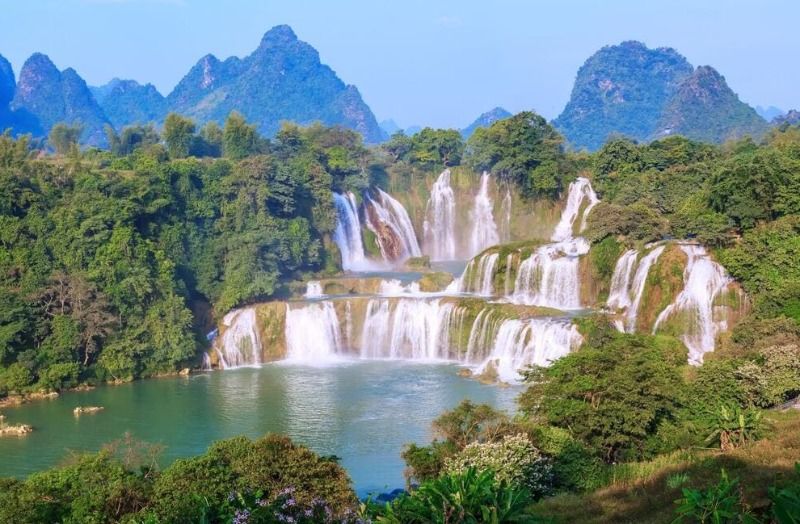
The reason this destination is a “once in a lifetime” experience lies in its unique attributes. Unlike any other waterfall in Vietnam, Ban Gioc offers a panoramic view of white foam against a backdrop of limestone mountains and golden rice fields. Moreover, the site provides a rare opportunity to stand at the very edge of the national border, where the cultural vibes of the ethnic Tay and Nung people enrich the travel experience. The combination of geological rarity and ethnic heritage makes it an unparalleled landmark in the Northeast circuit.
Which season is the most beautiful at Ban Gioc Waterfall?
There are two main seasons at Ban Gioc Waterfall: the water season (June to September) and the dry season (October to May), categorized by the volume of the Quay Son River.
The water season (June – Sept)
the water season is the most majestic period because of the high rainfall, the thunderous volume of the cascades, and the vibrant greenery of the surrounding forests.
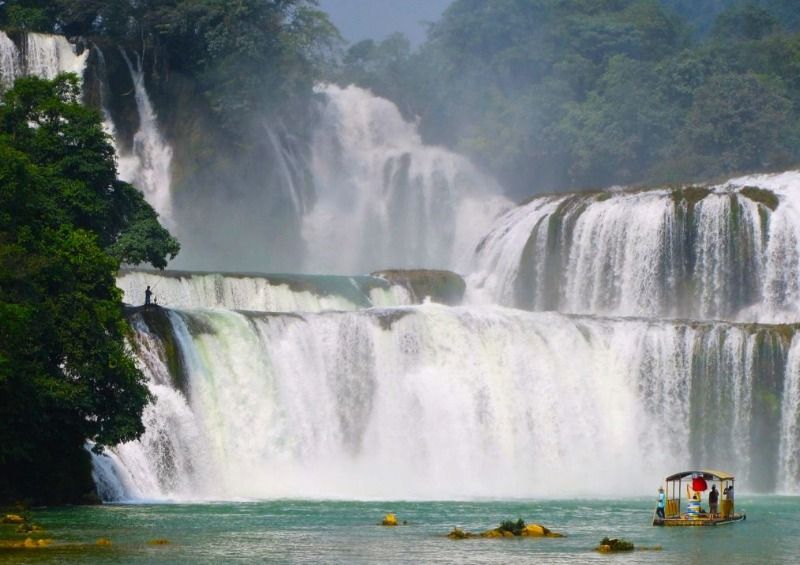
The peak of this grandeur usually occurs in July and August. Specifically, the massive volume of water plunging down creates a permanent mist at the foot of the waterfall, often resulting in vibrant rainbows on sunny days. Furthermore, this is the time when the waterfall truly lives up to its reputation as a powerhouse of nature, though travelers must be cautious of potential flash floods and slippery trails.
The golden/dry season (Oct – May)
The golden/dry season is a period of serenity originating from the receding water levels, characterized by emerald-clear pools and the ripening of surrounding rice terraces.
In contrast to the turbulence of summer, the waterfall during these months becomes graceful and poetic. Specifically, October is often considered the “perfect” month because it coincides with the harvest season in Trung Khanh, where the yellow of the rice fields contrasts beautifully with the blue of the river. Furthermore, the weather is cool and dry, making it ideal for trekking, photography, and exploring the nearby Nguom Ngao cave without the humidity of the rainy season.
Comparison of experiences between the water and dry seasons
The following comparison table illustrates the specific trade-offs for travelers:
| Criterion | Water Season (June – Sept) | Dry Season (Oct – May) |
| Water Color | Reddish-brown (due to alluvium) | Emerald Green (crystal clear) |
| Sound & Force | Extremely loud, powerful | Gentle, melodic |
| Landscape | Lush green jungle | Golden rice fields / Bare mountains |
| Safety | High risk of slippery paths | Very safe for trekking |
| Photography | Best for “Power” shots | Best for “Landscape/Poetic” shots |
Detailed 3 days 2 nights backpacking itinerary from Hanoi
Day 1: Hanoi – Cao Bang City – Ma Phuc Pass
The distance of 280km is not too far if you start early, as the roads are mostly paved, though the Ma Phuc Pass requires careful handling due to its 7-level steepness.
Most backpackers leave Hanoi at 6:00 AM via National Highway 3. Specifically, the drive takes about 6 to 7 hours. In addition, reaching Ma Phuc Pass in the late afternoon allows you to witness the sunset over the limestone peaks, which is one of the most iconic sights in Cao Bang. It is essential to check your brakes and tires before ascending, as the pass is known for its sharp curves.
Day 2: Journey Trung Khanh – Ban Gioc Waterfall – Nguom Ngao Cave
The second day is the core exploration phase originating from Cao Bang City to Trung Khanh, focusing on the waterfall and the magnificent stalactite system of Nguom Ngao.
To understand better, this leg of the trip is about 90km. Specifically, you should arrive at Ban Gioc by 9:00 AM to catch the best light for photos. After spending 3 hours at the waterfall, head to Nguom Ngao Cave, located just 3km away. Furthermore, the cave is famous for its “Silver Tree” and “Lotus” stalactite formations, which are millions of years old. Finishing the day at a local homestay in Khuoi Ky stone village will add a deep cultural layer to your trip.
Day 3: Cao Bang – Pac Bo – How to return to Hanoi
The return method involves a morning visit to the Pac Bo Historical Site and an afternoon drive back to Hanoi via the Cao Bang – Lang Son route to save time.
Specifically, visiting Pac Bo allows you to see the Suoi Le-nin (Lenin Creek) and Cac-Mac Mountain, which are integral to Vietnam’s revolutionary history. Following this, heading back through Lang Son is often preferred by backpackers as the road is flatter and allows for a stop to buy local specialties like roast duck. Important note: Ensure you leave Pac Bo by 1:00 PM to arrive in Hanoi before midnight.
In conclusion, your journey to Ban Gioc Waterfall is a multifaceted exploration of nature, history, and culture. By choosing the right season and following a structured itinerary, you can fully appreciate the majesty of this northern gem.