
 Home
Home About
About Tours
Tours Bikes Rental
 Contact
The Ha Giang Loop map covers a circular route of approximately 350km starting and ending in Ha Giang City, passing through four core districts Quan Ba, Yen Minh, Dong Van, and Meo Vac — each offering dramatically different terrain, altitude, and cultural character
Below, this guide walks through every layer of the Ha Giang Loop map from macro route structure down to individual pass characteristics pair it with a detailed Hagiangloop itinerary to plan, navigate, and ride with full confidence.
The Ha Giang Loop map includes several sections
The Ha Giang Loop map divides into four primary road segments Ha Giang to Quan Ba, Quan Ba to Yen Minh, Yen Minh to Dong Van, and Dong Van to Meo Vac each classified by distance, elevation gain, and technical difficulty for riders.
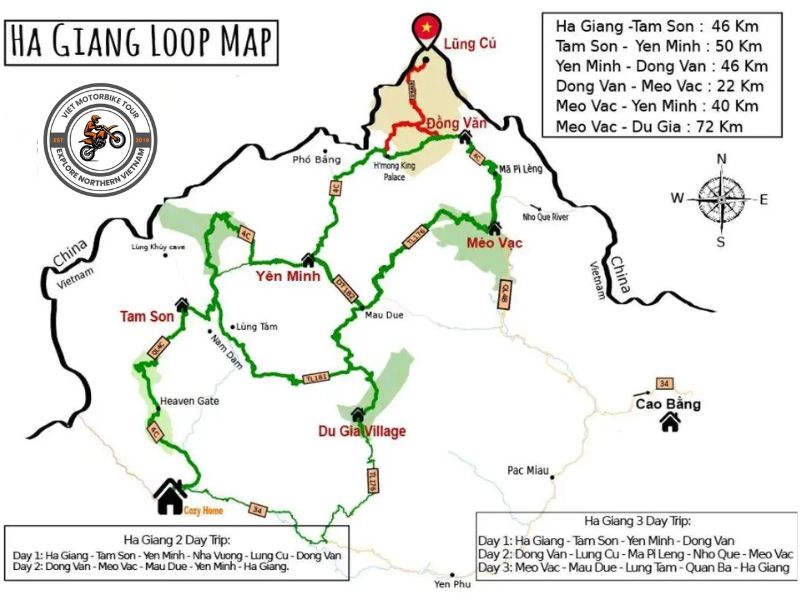
1. Ha Giang to Quan Ba: The Heavenly Gate Begins the Journey
The opening segment from Ha Giang City to Quan Ba covers approximately 46km and introduces riders to the loop’s signature landscape through the famous Quan Ba Heaven’s Gate Pass (Cổng Trời), a mountain saddle at around 1,500 meters altitude that frames the first panoramic view of karst peaks and rice terrace valleys below.
On the map, this segment follows QL4C northward from Ha Giang City. Key landmarks to identify include:
- Quan Ba Heaven’s Gate (Cổng Trời Quản Bạ): The first major viewpoint and a natural geographic marker on the map, sitting at roughly the midpoint of this segment
- Twin Fairy Mountains (Núi Đôi Cô Tiên): Two near-identical limestone domes visible from the Heaven’s Gate viewpoint, a unique geological formation found nowhere else on the loop
- Tam Son Town: The district capital of Quan Ba, functioning as the primary overnight stop for riders completing only this segment on day one

2 .Quan Ba to Yen Minh: Valleys and Primeval Forests
The Quan Ba to Yen Minh segment runs approximately 46km through a transitional landscape zone lower valleys, dense subtropical forest, and small ethnic minority villages making it the least technically demanding section of the full loop and a natural recovery stretch between the two most challenging halves.
On the map, this segment dips in elevation before gradually climbing toward Yen Minh Town. Key map notes for this stretch include:
- Forest corridor between Quan Ba and Yen Minh: The road passes through protected forest zones with limited commercial development, meaning fuel stations are sparse riders should fill up in Tam Son before departing
- Ethnic minority villages: H’mong and Dao communities are scattered along secondary tracks branching from the main road; these are marked on detailed loop maps but invisible on standard navigation apps
- Yen Minh Town: A larger market town than Quan Ba, with more accommodation options and the last reliable fuel and food stop before the more remote Dong Van section — riders who rent motorbike Ha Giang in the city should confirm their bike’s fuel range here before pushing onward.
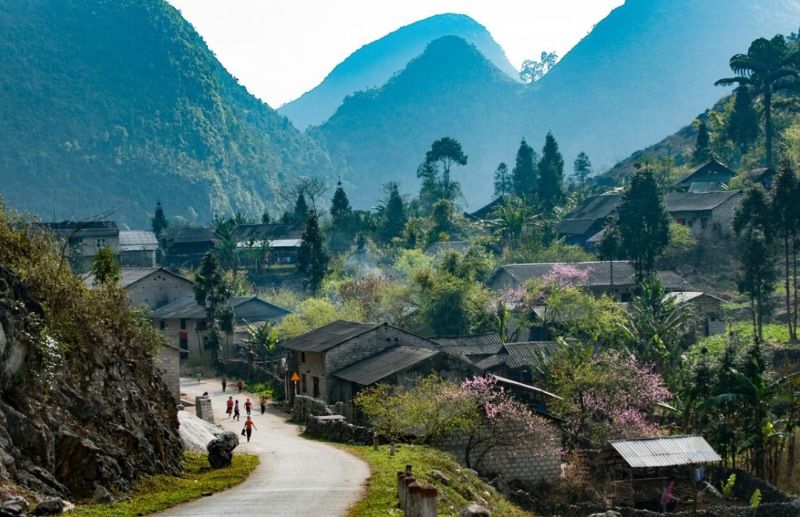
3. Yen Minh to Dong Van: The Legendary Stone Plateau
The Yen Minh to Dong Van segment spans roughly 45km across the heart of the Dong Van Karst Plateau, passing through Pho Cao village — famous for buckwheat flower fields from October to December — and entering the UNESCO Geopark boundary, which on official loop maps is marked as the zone requiring a border area permit (giấy phép vùng biên).This segment represents the plateau’s full character: bare limestone ridges with almost no tree cover, narrow roads carved into cliff faces, and long exposed sections where wind and weather dramatically affect riding conditions. Key map landmarks include:
- Pho Cao Village: A key photography stop, particularly during buckwheat flower season when the valley floor turns pink and white
- Lung Tao area: A dramatic pass section where the road narrows and the karst formations press close on both sides
- Dong Van Old Quarter (Phố Cổ Đồng Văn): The destination town, featuring a preserved French colonial market area and the starting point for rides to Lung Cu Flag Tower
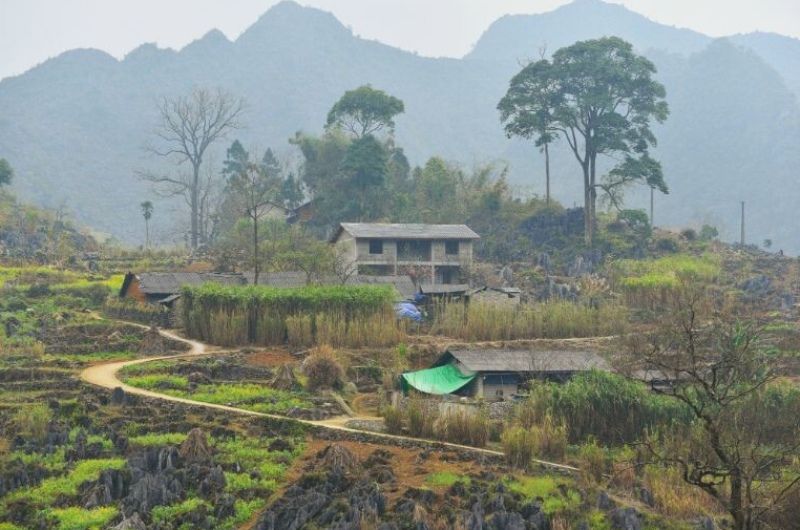
4. Dong Van to Meo Vac & Ma Pi Leng Pass: The Peak of the Loop
The Dong Van to Meo Vac segment covers approximately 24km but contains the single most significant landmark on the entire Ha Giang Loop map: Ma Pi Leng Pass (Đèo Mã Pí Lèng), consistently rated among the most dramatic mountain passes in Southeast Asia.
Ma Pi Leng sits at approximately 1,400 meters altitude and traverses a cliff face above the Nho Que River, which runs 700 meters directly below at the bottom of Tu San Canyon — the deepest river gorge in Vietnam. On topographic loop maps, this section is visually unmistakable: a thin road line tracing a sheer drop with elevation contour lines packed impossibly close together.
Key map notes for this segment:
- Ma Pi Leng Pass panorama viewpoint: A dedicated pull-off area marked on loop maps approximately halfway across the pass, offering the most photographed view on the entire route
- Tu San Canyon (Hẻm Vực Tu Sản): Visible from the pass road above, accessible via boat trip from Meo Vac — marked separately on detailed maps as a secondary activity point
- Meo Vac Town: The endpoint of the most dramatic riding day, a compact market town with guesthouse clusters and the southward return route back toward Ha Giang City — travelers who prefer local expertise over self-navigation may want to arrange a ha giang easy rider guide before tackling the return leg
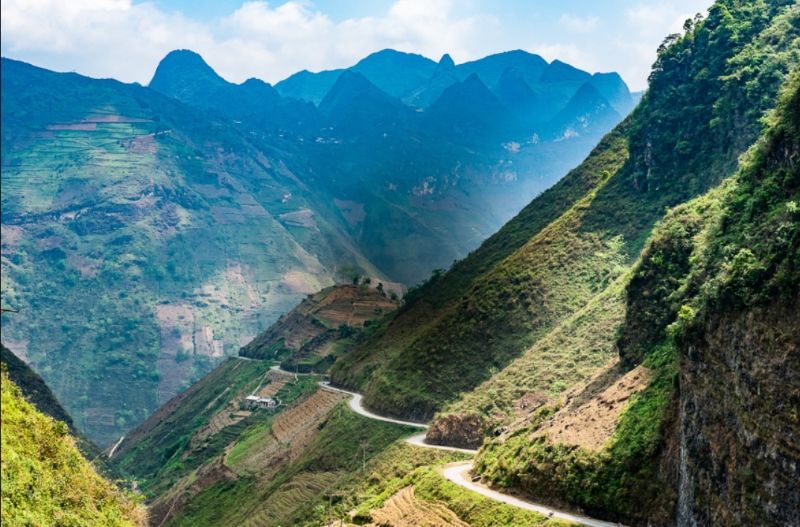
Some must-see attractions are on the Ha Giang Loop map
The natural landmarks on the Ha Giang Loop map are defined by geological scale these are formations that took hundreds of millions of years to create and cannot be found together anywhere else in Vietnam.
| Landmark | Location on Map | Why It Matters |
|---|---|---|
| Ma Pi Leng Pass | Between Dong Van and Meo Vac | Highest-rated scenic pass; 700m drop to Nho Que River below |
| Twin Fairy Mountains | Quan Ba District | Twin limestone domes visible from Heaven’s Gate viewpoint |
| Nho Que River / Tu San Canyon | Meo Vac District | Deepest river gorge in Vietnam; turquoise water surrounded by black limestone walls |
| Heaven’s Gate Pass | Ha Giang – Quan Ba border | First major panoramic viewpoint; framed rice terraces and karst valleys |
| Pho Cao Buckwheat Fields | Yen Minh – Dong Van transition | Seasonal (Oct–Dec); transforms the valley floor into pink-white color fields |
The best offline map app for the Ha Giang Loop is known
Maps.me leads for general offline navigation on the Ha Giang Loop, OsmAnd excels for topographic detail and elevation data, and Google Maps offline is the weakest of the three for rural mountain terrain useful as a backup but not a primary tool.
| App | Offline Capability | Road Accuracy for Loop | Elevation Data | Best For |
|---|---|---|---|---|
| Maps.me | Full offline after download | High — community-updated OSM data | Basic | First-time riders wanting simplicity |
| OsmAnd | Full offline with detailed layers | High — same OSM base with more control | Detailed topographic layers | Experienced riders who read elevation profiles |
| Google Maps Offline | Limited — caches tiles, not full routing | Medium — gaps in remote sections | No | Backup use in towns only |