
 Home
 About
 Tours
 Bikes Rental
 Contact
The Ha Giang Loop solo is not just a motorbike route it is 350 kilometers of raw limestone mountains, hairpin passes, and ethnic minority villages that test every rider who dares to go alone. At Viet Motorbike Tour, we have guided hundreds of first-time solo riders through this legendary circuit, and the pattern is always the same: those who arrive prepared leave with the trip of their lives; those who don’t arrive unprepared leave with regrets or worse, injuries.
Whether you are debating self-riding versus hiring an Easy Rider, unsure which documents you actually need, or trying to budget realistically for the first time, this guide covers it all. Eight practical, field-tested tips that separate a smooth solo adventure from a stressful one. Read every word before you ride.
What Is the Ha Giang Loop and Why Is It an Ideal Route for Solo Riders?
The Ha Giang Loop is a circular motorbike route stretching more than 350 km, beginning and ending in Ha Giang city, passing through four highland districts — Quan Ba, Yen Minh, Dong Van, and Meo Vac — the areas that concentrate the most dramatic karst scenery and ethnic minority culture in Vietnam’s northernmost region.
The name “Loop” reflects the shape of the route itself: a closed circuit that brings riders back to their starting point after 3–5 days. The route crosses the Dong Van Karst Plateau — a UNESCO-recognized geopark since 2010 — spanning more than 2,300 square kilometers of towering limestone mountains, deep valleys, and villages belonging to 17 ethnic minority groups living at elevations between 1,000 and over 1,600 meters above sea level.
So why does the Ha Giang Loop work particularly well for solo travel? Three core reasons stand out
- The route has a natural structure that means a solo rider is never truly alone unless they choose to be. Homestays, guesthouses, and rest stops throughout the loop naturally gather solo travelers from around the world. A dinner at a homestay frequently becomes a shared table without anyone planning it that way; a viewpoint becomes an unscheduled meeting place with new riding companions.
- Going alone gives you complete control over the pace of the journey. You can stop for thirty minutes in a rice terrace valley without waiting on anyone, skip a crowded viewpoint and take a back road into a lesser-known village, or adjust your daily route based on weather without negotiating with a group.
- The community and local context of Ha Giang is genuinely friendly toward solo travelers. Local residents have been accustomed to solo foreign riders for years; most homestay owners speak enough English to give directions and basic assistance; and mechanics appear at regular intervals along the main road. These are factors that cannot be taken for granted when planning a first solo ride through remote mountains.
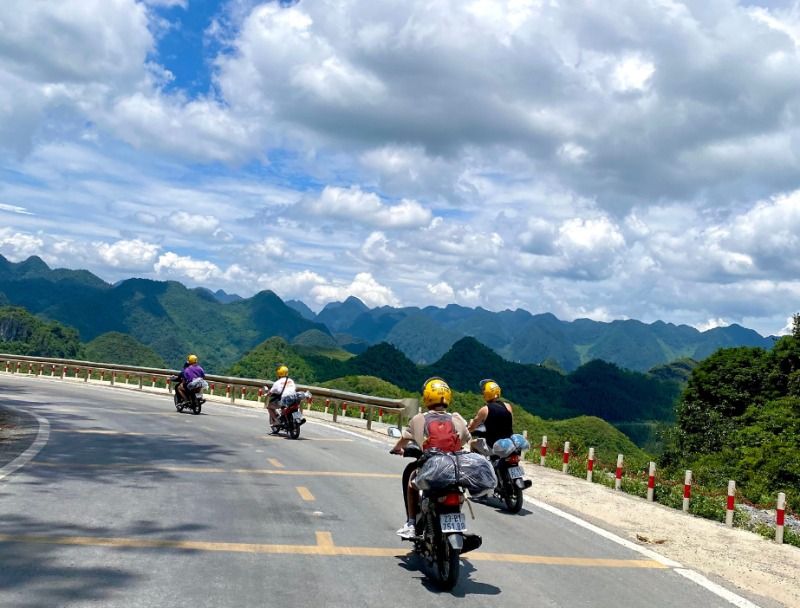
The Real Risks When Riding Ha Giang Loop Solo
There are four main risk categories that solo riders need to identify before the trip, listed from most common to most serious.
- Low-speed falls: This is the most frequently occurring type of accident, affecting an estimated 5–10% of loop riders according to estimates from local rental shops and homestay operators. The primary causes are loose gravel on road surfaces after rain, drainage channels crossing the road, and uneven patches of asphalt repair work. The result is typically minor scrapes and small amounts of bike damage, with riders able to continue the journey after basic first aid.
- Mechanical problems: Punctures, running out of fuel between stretches, a slipped chain, or weakened brakes after extended descents are issues that a solo rider must handle independently or seek help for without a riding companion nearby. Mechanics are present at intervals along the main route, but the gap between them can reach 15–20 km on some stretches.
- Loss of signal and wrong turns: The area between Yen Minh and Dong Van, particularly the side roads into villages, regularly has no mobile signal. Without an offline map and without familiarity with the terrain, a solo rider can easily take the wrong fork and lose significant time.
- Serious injury: An estimated 1–2% of loop riders experience injuries requiring medical intervention, including broken bones, concussions, or significant road rash. This risk increases sharply with three specific behaviors: riding after consuming alcohol, riding at high speed through blind corners, and continuing to ride after dark. Cases requiring serious emergency care must be transferred to Hanoi — more than 300 km from central Ha Giang and approximately 6–8 hours by ambulance.
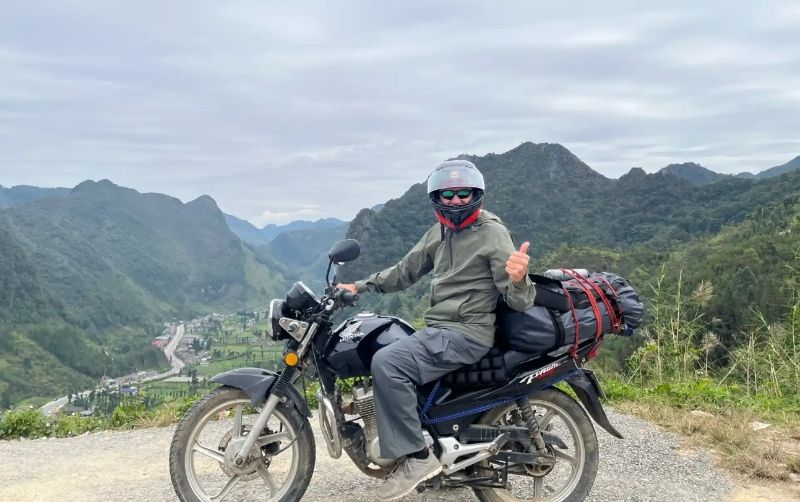
Do Male and Female Solo Travelers Face Different Risks?
In terms of road safety and riding technique, the risks between men and women are not meaningfully different — this is a question of experience and skill, not gender. That said, there are a few considerations specific to women riding alone worth acknowledging.
- Where the risks are the same: The mountain passes, loose gravel, weather conditions, and mechanical hazards affect every rider identically. The H’Mong, Tay, and Dao communities along the Ha Giang Loop are consistently described as respectful and welcoming — incidents of harassment or crime targeting solo female tourists are extremely rare.
- Where the experience differs for women traveling alone: Prioritize homestays with positive reviews from previous solo female travelers. Some isolated stretches between two stops can feel exposed if the bike breaks down near dusk — keeping the daily route aligned with early-morning starts and reaching each night’s stop before 17:30 reduces this situation meaningfully. Joining Facebook groups such as “Ha Giang Loop Travelers” or “Solo Female Travelers Vietnam” to connect with people on overlapping itineraries before departure is a practical strategy many solo female riders use effectively.
8 Tips You Cannot Skip When Riding the Ha Giang Loop Solo for the First Time
- 1. Depart before 07:30 each morning. This is the single most important tip and the one most frequently ignored. Each day on the Ha Giang Loop, you will cover an average of 80–100 km across mountain terrain — the realistic riding speed rarely exceeds 30–40 km/h. A 09:00 departure means you are still riding in the afternoon, when fog thickens on the upper passes and light drops quickly. Additionally, the most photographically rewarding viewpoints — such as the Heaven Gate at Quan Ba or the Ma Pi Leng overlook above the Nho Que River — are most crowded between 09:00 and 12:00. Starting early means arriving before the crowds and having the shots to yourself.
- 2. Book homestays in Dong Van and Meo Vac at least 1–2 days in advance. These two stops are the busiest on the entire route, particularly during the peak season from September to November (buckwheat flower season) and in March–April. The number of quality homestays offering private rooms or reliable dorm beds is limited — turning up without a reservation and finding everything full is not an urban legend, it is a documented reality that unplanned riders encounter regularly. Booking.com or messaging homestays directly via Zalo or Messenger are the two most commonly used approaches.
- 3. Download offline maps before leaving Ha Giang city. Mobile signal is intermittent or completely absent on several stretches between Yen Minh and Dong Van, particularly on back roads leading into villages. Maps.me (free Vietnam map download) and Google Maps offline mode are the two tools most consistently recommended by riders who have completed the loop. If using Google Maps offline, download the specific Ha Giang Province area rather than all of Vietnam — the latter wastes storage space unnecessarily. Purchase a Viettel or Vinaphone SIM card in Hanoi, as these two networks provide the best coverage in Vietnam’s northern highlands.
- 4. Inspect the bike every morning before riding, without exception. A five-minute checklist each morning: check tire pressure on both wheels, test both hand brakes, gently shake the handlebars to feel the front fork, verify the headlight and rear light are working, and press the horn. Refuel when the tank drops to roughly one third — do not wait for the warning light before stopping. The stretch from Dong Van to Meo Vac through Ma Pi Leng Pass is the longest section on the main route without a fuel station.
- 5. Keep speed under 30 km/h on passes and blind corners. The official speed limit on mountain roads is 50 km/h, but for a first-time rider unfamiliar with the terrain, 30 km/h is the practical safety threshold. Data compiled by local tour operators suggests that riders who go slowly, avoid alcohol on riding days, and stop before dark complete the full route with an incident rate that approaches zero across thousands of loops. A simple test: if you cannot see far enough ahead to stop in time, you are already going too fast.
- 6. Reach each night’s stop at least one hour before dark. There are no streetlights along the majority of the Ha Giang Loop. After dark, the risk from unseen potholes, livestock crossing the road, and oncoming trucks on narrow passes multiplies sharply. Most serious accidents happen after 17:30 when riders push to complete the final stretch of the day in fading light. Set a daily alarm at 16:00 to check how far you are from the night’s destination.
- 7. Communicate with local people using simple language and a genuinely open attitude. The H’Mong, Tay, and Dao people living along the Ha Giang Loop are accustomed to foreign visitors, but they respond warmly to real respect rather than performative enthusiasm. Learning 5–10 basic Vietnamese phrases — “xin chào” (hello), “cảm ơn” (thank you), “ngon quá” (this is delicious), “bao nhiêu tiền” (how much does this cost) — makes a clearly noticeable difference in how local people receive you. At the Dong Van or Meo Vac market days, do not point a camera at anyone without first asking permission through eye contact or gesture — this is an unwritten rule that is widely respected by experienced loop riders.
- 8. Keep at least 1–2 million VND in cash as an emergency reserve beyond your day-to-day budget. ATMs are scarce and frequently run out of cash in Dong Van and Meo Vac during busy weekends in peak season. Emergency cash is the safety net for situations that cannot be predicted: a puncture repair (approximately 150,000 VND), an oil change (approximately 100,000 VND), or an extra night’s stay because the weather has turned dangerous. A solo rider has no one to split unexpected costs with — this is a practical reality that needs to be budgeted for before departure.
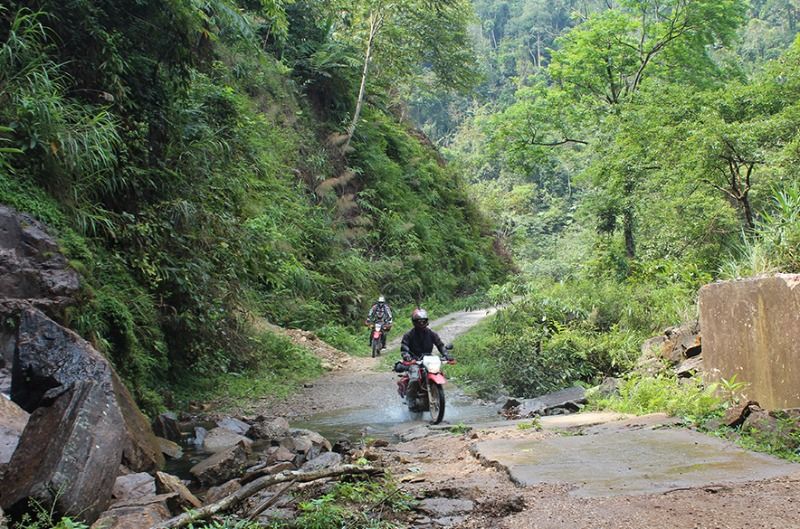
How Much Does It Cost to Ride the Ha Giang Loop Solo?
A realistic budget for 4 days of independent riding on the Ha Giang Loop ranges from 3.5–4.5 million VND (140–180 USD), covering a return sleeper bus from Hanoi, motorbike rental, fuel, border permit, homestay accommodation, and meals.
If you choose to ride as a passenger with an Easy Rider guide, the all-in price for a 3-day package typically sits at 3.8–4.5 million VND (152–180 USD). A private 4-seat Jeep tour package for 3 days and 2 nights runs approximately 5–8.5 million VND (200–340 USD).
The table below breaks down each cost category for a 4-day self-ride
| Item | Estimated cost (VND) | Estimated cost (USD) | Notes |
|---|---|---|---|
| Hanoi–Ha Giang–Hanoi return sleeper bus | 640,000–1,000,000 | 26–40 | VIP cabin costs more but sleeps better |
| Honda Wave semi-auto rental (4 days) | 600,000–720,000 | 24–29 | Honda XR150 manual costs 1.2 million for 4 days |
| Fuel (full route ~350 km) | 250,000–350,000 | 10–14 | Refuel whenever you see a station |
| Border area permit | 230,000 | ~10 | Issued at Ha Giang City Police or via rental shop |
| Homestay (4 nights, dorm or shared room) | 720,000–1,200,000 | 29–48 | Private room roughly doubles the cost |
| Food (4 days × 2–3 meals) | 400,000–800,000 | 16–32 | Eating locally is very affordable |
| Entry fees (Lung Cu, King Palace, etc.) | 100,000–200,000 | 4–8 | Most viewpoints are free |
| Mechanical emergency reserve | 500,000–1,000,000 | 20–40 | Do not skip this line item |
| Total | ~3.44–5.5 million | ~138–221 USD | Varies by comfort level chosen |
Self-Ride, Easy Rider, or Jeep Tour — What Should You Choose When Traveling Alone?
Self-riding wins on cost and route freedom; Easy Rider is the optimal choice for the majority of solo travelers in terms of balance between experience, safety, and value; Jeep tour suits those who cannot ride a motorbike or are traveling during the rainy season.
- Self-riding (approximately 90–120 USD for 3 days, excluding bus): The option that delivers the most freedom but requires genuine experience on mountainous terrain. Riders who are only comfortable on a scooter on flat city streets in Bali or Thailand often misjudge their readiness — Ha Giang demands a genuinely different level of riding technique. The estimated accident probability for inexperienced riders is 3–5 times higher than for experienced riders, according to figures cited by local tour operators.
- Easy Rider (all-in 3-day package approximately 152–180 USD): You sit as a passenger behind a local driver who knows every corner, every pothole, and every best photograph spot. This is the option most consistently rated highest by solo travelers because you still have the physical sensation of being on a motorbike moving through the landscape — you simply are not responsible for the technical demands of navigating it. Easy Rider guides typically narrate stories about local culture and history throughout the ride, a dimension that is simply unavailable when riding alone.
- Jeep tour (3 days, 2 nights approximately 200–340 USD): Most appropriate for riders who cannot operate a motorbike, those traveling in June–August during the rainy season, or anyone prioritizing comfort and the flexibility to stop at locations with no motorbike parking area. In a Jeep, you still travel through Ma Pi Leng Pass and reach every major destination — but you are watching it through a window rather than feeling the wind and the gradient directly.

Above are the 8 essential tips that every first-time solo rider needs before taking on the Ha Giang Loop solo. We hope this guide gives you the confidence to set off alone and return with memories that last a lifetime.When you are ready to ride, Viet Motorbike Tour is here to support you. We provide trusted, high-quality self-ride motorbike rental in Ha Giang well-maintained bikes, transparent pricing, and local support every kilometer of the way. Your solo adventure starts here.