
 Home
Home About
About Tours
Tours Bikes Rental
 Contact
Choosing the right motorcycle transmission can make or break your riding experience — especially when navigating Vietnam’s bustling city streets or winding mountain roads. A semi automatic transmission motorcycle sits at the crossroads between the control of a manual clutch bike and the effortless convenience of a fully automatic scooter, making it one of the most misunderstood yet practical choices on the market today.
Whether you are planning a self-guided motorbike adventure through Vietnam or simply choosing your next daily ride, this comparison Viet Motorbike Tour will help you decide with confidence.
What Is a Semi-Automatic Transmission Motorcycle?
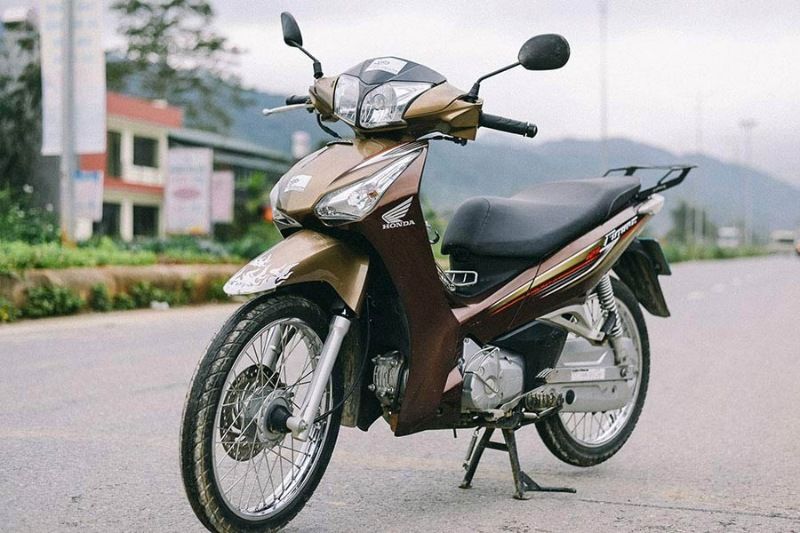
A semi-automatic transmission motorcycle is a bike that retains a multi-speed sequential gearbox requiring the rider to shift gears with the left foot, but eliminates the clutch lever on the handlebar entirely by automating clutch engagement through a centrifugal or electronic clutch system.
To understand this definition fully, it helps to place the semi-automatic motorcycle in its correct position within the broader spectrum of motorcycle transmission types available today.
Modern motorcycle transmissions fall into three major categories: fully manual clutch bikes (manual), semi-automatic bikes, and fully automatic CVT scooters. The semi-automatic sits precisely in the middle — it keeps the gear-shifting pedal of a manual bike but removes the clutch lever like a scooter. The fundamental difference lies entirely in how the clutch is handled: instead of the rider controlling clutch engagement manually with their left hand, the clutch operates automatically through a mechanical or electronic system inside the engine.
Depending on the market, era, and specific system, this motorcycle type carries several interchangeable names: semi-automatic motorcycle, clutchless manual, automated manual transmission (AMT), or colloquially a no-clutch gear bike. All of these names describe the same core operating principle.
How Does the Semi-Automatic Transmission System Work?
The semi-automatic transmission system on a motorcycle operates through three core components working in coordination: an automatic centrifugal clutch, a sequential multi-speed mechanical gearbox, and a foot-operated gear shift pedal — these three elements together eliminate the need for a handlebar clutch lever entirely.
The most important component in the system is the centrifugal clutch. This is a purely mechanical device that operates on straightforward physics: when engine RPM is low — such as when the bike is idling or stationary — centrifugal weights inside the clutch assembly sit retracted inward, making no contact with the outer housing. In this state, the engine is fully disconnected from the gearbox, which means the bike will not stall even when the rider is stopped in first gear with no clutch input. As the rider opens the throttle and engine RPM rises, centrifugal force pushes the weights outward until they make contact with the clutch housing, gradually transferring increasing amounts of engine torque to the gearbox — the bike begins moving smoothly and naturally.
This entire process is fully automatic and requires zero input from the rider’s hands. The only active input the rider provides is pressing the gear shift pedal with the left foot to move up through gears as speed increases, or pressing down to downshift when slowing. At the moment of each gear change, engine RPM briefly dips enough for the centrifugal clutch to partially disengage, allowing the gear to change cleanly, after which the clutch re-engages automatically as RPM rises again. The entire sequence happens in a fraction of a second, and the rider feels none of the mechanical complexity behind it.
This is precisely why a semi-automatic motorcycle does not stall at traffic lights, does not require the rider to find the friction point of a clutch when pulling away, and does not demand the coordinated left-hand and left-foot choreography that makes manual clutch bikes challenging for new riders — the system handles all of that automatically.
What Types of Semi-Automatic Motorcycles Exist?
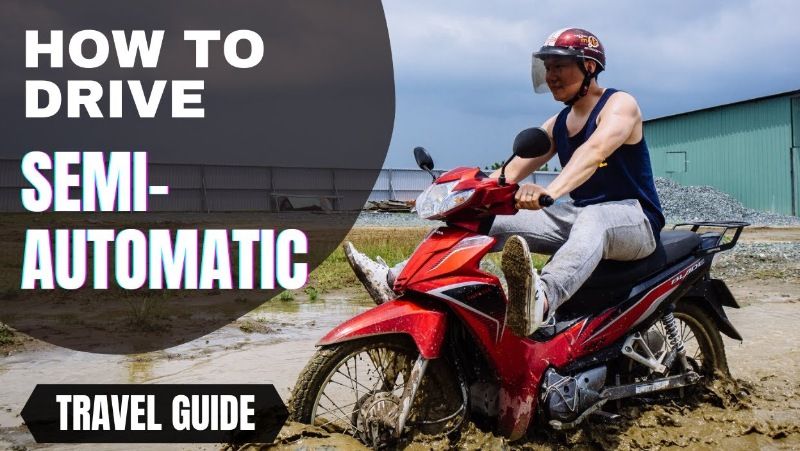
- Traditional Centrifugal Clutch: This is the most widespread and historically longest-standing type. The system is entirely mechanical, with no electronic control units involved. The clutch operates purely on the physics of centrifugal force — simple, robust, and inexpensive to maintain. Representative models include the Honda Wave series, Honda Blade, Honda Super Cub C125, and the majority of underbone commuter motorcycles sold across Southeast Asia. This is the type that the vast majority of everyday riders in markets like Vietnam and Thailand use daily.
- DCT (Dual Clutch Transmission) and E-Clutch: This is the modern, electronically controlled iteration of semi-automatic technology. DCT uses two separate clutch packs controlled by an electronic management system, allowing near-instantaneous gear changes with exceptional smoothness. E-Clutch, introduced by Honda on models like the CBR650R, retains the conventional gearbox architecture but replaces the clutch lever with an intelligent electronic actuator. Both systems allow the rider to shift manually via the foot pedal or handlebar paddles, while the electronics handle all clutch engagement automatically. Representative models include the Honda NC750X DCT, Honda Rebel 1100 DCT, and Honda CBR650R E-Clutch all sitting in the mid-to-premium price segment.
Is a Semi-Automatic Motorcycle Actually Easier to Ride Than a Manual Clutch Bike?
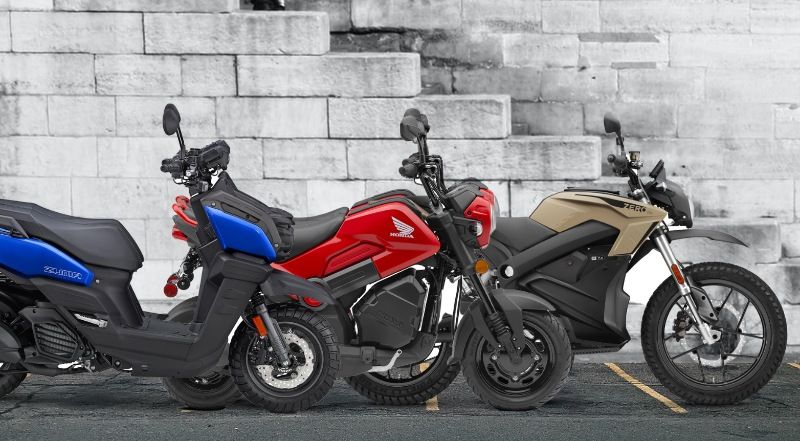
A semi-automatic motorcycle is genuinely easier to ride than a manual clutch bike for three concrete reasons: the rider never needs to operate a clutch lever, stalling the engine at a stop becomes nearly impossible, and the complex left-hand and left-foot coordination that challenges most new riders is entirely eliminated — however, this does not mean effortless like a scooter, because the rider still decides when and how to shift gears.
That distinction matters because “easier than manual” and “as easy as a scooter” describe two very different experiences. To assess this accurately, the semi-automatic needs to be compared directly against both the manual clutch bike and the automatic scooter across specific, measurable criteria.
Semi-Automatic vs Manual Clutch Motorcycle
The semi-automatic motorcycle wins on ease of learning and urban suitability, while the manual clutch motorcycle delivers superior active control and handling flexibility in demanding riding conditions such as steep hills, loose terrain, or high-speed cornering.
The table below compares both types across the most important operational criteria a buyer needs to evaluate before making a purchase decision:
| Criteria | Semi-Automatic | Manual Clutch |
|---|---|---|
| Clutch lever | None | Required, left hand |
| Gear shift pedal | Yes, left foot | Yes, left foot |
| Risk of stalling | Very low | Higher, especially for beginners |
| Active rider control | Limited by automatic clutch | Full control over clutch engagement |
| Suitability for beginners | Excellent | Requires learning time |
| Urban stop-and-go suitability | Very good | More tiring on the left hand |
| Sporty or technical riding | Less suited | Clear advantage |
| Maintenance cost | Low, simpler mechanicals | Low, slightly more components |
| Fuel efficiency | Comparable | Comparable |
Semi-Automatic vs Automatic Scooter
The automatic CVT scooter is more convenient in dense urban stop-and-go traffic because the rider only manages throttle and brakes with zero gear input required; but the semi-automatic motorcycle holds meaningful advantages in fuel efficiency at highway speeds, purchase price, maintenance cost, and performance across varied terrain.
The table below compares a semi-automatic motorcycle directly against an automatic CVT scooter across factors that affect real-world daily use:
| Criteria | Semi-Automatic Motorcycle | Automatic CVT Scooter |
|---|---|---|
| Transmission type | Stepped gears (3–5 speeds) | Continuously variable (CVT) |
| Rider input while moving | Shift gears with left foot | Throttle and brake only |
| At traffic lights | Hold gear or return to neutral | No action needed |
| Highway fuel efficiency | Better at sustained speeds | Better in slow urban traffic |
| Storage space | Minimal, usually no underseat storage | Wide underseat compartment |
| Purchase price | Lower in equivalent power segment | Generally higher |
| Maintenance cost | Simpler, cheaper parts | More complex CVT system |
| Performance on inclines | More controlled with stepped gears | Less efficient under load |
| Terrain versatility | More flexible | Best suited to flat roads |
The Advantages and Disadvantages of a Semi-Automatic Transmission Motorcycle
The Key Advantages of a Semi-Automatic Motorcycle
A semi-automatic motorcycle offers five core advantages that make it a highly practical daily transportation choice across many markets:
- No clutch lever means significantly reduced hand fatigue in urban conditions. This is the most direct and immediately felt benefit. In dense city traffic where a rider might stop and restart 30 to 50 times in a single commute a manual clutch rider must squeeze and release the clutch lever at every single stop and departure. The semi-automatic eliminates this entire sequence. The rider brakes to a stop, the engine keeps running without any input, and when the light turns green, a gentle twist of the throttle gets the bike moving again.
- The risk of stalling is dramatically lower compared to a manual clutch motorcycle. The centrifugal clutch automatically disconnects at low RPM, meaning that even if the rider brakes hard and stops suddenly without returning to neutral or releasing throttle slowly, the engine continues running undisturbed. This feature alone removes one of the most frustrating and confidence-damaging experiences for new riders the public stall at a busy intersection.
- Fuel efficiency is better than a CVT scooter at sustained highway speeds. A stepped gearbox allows the engine to hold its optimal RPM range at any given road speed the rider selects the appropriate gear for the conditions, and the engine runs efficiently within that gear. CVT transmissions, by contrast, continuously vary the ratio and tend to hold the engine at slightly higher RPM under load, which reduces efficiency at speeds above 60–70 km/h. Models like the Honda Wave Alpha and Honda Super Cub C125 consistently achieve real-world fuel consumption in the range of 1.5 to 2.0 liters per 100 km under normal riding conditions.
- Purchase price is lower than an equivalent automatic scooter. Across comparable engine displacement and brand segments, semi-automatic commuter motorcycles are consistently priced 30 to 50 percent lower than automatic scooters from the same manufacturer. This price gap is a decisive factor for students, first-time buyers, and riders operating on a fixed budget.
Fifth, maintenance is simple, parts are universally available, and repair costs are low. The traditional centrifugal clutch semi-automatic has far fewer electronic components than a CVT scooter, making it serviceable by any mechanic in any location. Replacement parts are widely stocked, inexpensive, and the mechanical systems are well-understood by technicians across all market segments.
The Disadvantages Worth Knowing Before Choosing a Semi-Automatic Motorcycle
Alongside its genuine strengths, the semi-automatic motorcycle has four real disadvantages that buyers need to assess honestly before committing:
- reduced active control compared to a manual clutch motorcycle. When climbing a slippery hill, cornering on loose surfaces, or engine-braking on a long downhill, a manual clutch rider can intervene precisely — slipping the clutch, modulating engagement, using engine braking as a control tool. On a semi-automatic, the centrifugal clutch makes those decisions based on RPM rather than rider intention. The result is a machine that is easier to ride in standard conditions but less responsive to advanced rider inputs in demanding situations.
- No underseat storage space like an automatic scooter. Semi-automatic underbone motorcycles typically have no underseat storage compartment, or a very small one. Riders who regularly carry a laptop bag, groceries, or personal items must rely on a rear rack or external bags — a meaningful daily inconvenience compared to the 20 to 30 liter underseat compartment found in most mid-size scooters.
- The centrifugal clutch wears out faster if ridden incorrectly. Riding in a low gear at high throttle for extended periods — for example, staying in first or second gear while the engine is pulling hard instead of upshifting — creates excessive friction across the clutch contact surfaces and accelerates wear significantly. Early warning signs include the bike failing to accelerate despite high throttle input, a burning smell at departure, or a slipping sensation where engine RPM rises but road speed does not match. Replacement cost for a complete centrifugal clutch assembly typically ranges from moderate to reasonable depending on the model, but it is a repair that can be avoided almost entirely with correct riding habits.
- Not the right fit for riders who value the full manual riding experience. For riders who consider the physical act of working a clutch lever — finding the friction point, timing the release, blipping the throttle on downshifts a fundamental part of what makes riding enjoyable, a semi-automatic motorcycle will feel disconnected and unsatisfying. This is not a technical flaw but a genuine mismatch between the bike’s character and the rider’s expectations.
The Most Popular Semi-Automatic Motorcycles Available Today
Entry-Level Semi-Automatic Motorcycles Under 30 Million VND
- Honda Wave Alpha 110cc — Consistently one of the best-selling motorcycles in Vietnam year after year, with a starting price around 17 to 18 million VND. The Wave Alpha is renowned for exceptional durability, real-world fuel consumption in the 1.6 to 1.8 liters per 100 km range, and extremely low maintenance costs. The semi-automatic system is the traditional centrifugal clutch type at its most reliable and proven. Best suited for students, workers, and commuters covering moderate daily distances on a tight budget.
- Honda Blade 110cc — A sportier sibling to the Wave Alpha, priced from 20 to 22 million VND. The Blade features a younger, more aggressive visual design, front disc brake, and ABS on higher trim levels. It uses the same proven semi-automatic centrifugal clutch mechanism as the Wave Alpha but targets riders who want a more dynamic aesthetic without a significant price premium.
- Yamaha Sirius 110cc — The direct competitor to the Wave Alpha from Yamaha’s lineup, priced from 19 to 21 million VND. The Sirius is consistently praised for smooth engine character and clean design, with fuel efficiency comparable to the Wave Alpha. A strong choice for riders who prefer Yamaha’s brand positioning and want proven reliability in the entry-level commuter segment.
- Suzuki Axelo 125cc — Less prominent than the Honda and Yamaha options in terms of market share, but notable for its 125cc engine delivering slightly more performance than 110cc competitors, at a competitive price between 20 and 24 million VND. A practical option for riders who want a bit more power headroom while staying within a tight budget.
Mid-to-Premium Semi-Automatic Motorcycles
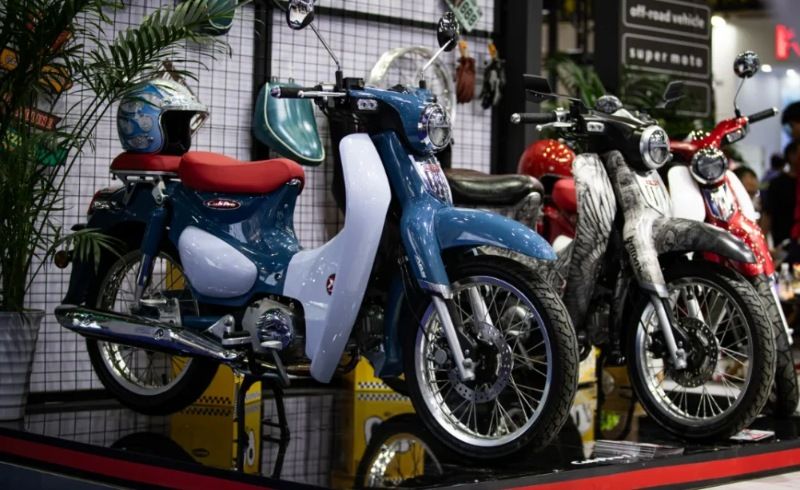
- Honda Super Cub C125 — A living legend reborn with classic retro design and modern engineering, priced from 45 to 50 million VND. The Super Cub C125 uses a 125cc fuel-injected engine, a four-speed semi-automatic gearbox with no clutch lever, front disc brake, and ABS. The Super Cub holds the record as the most produced motor vehicle in human history, with over 100 million units manufactured — a testament to how effective its semi-automatic mechanism has been at making motorcycle riding accessible across demographics and geographies. Best suited for riders who value heritage, build quality, and are willing to invest in a machine with proven long-term reliability.
- Honda Trail 125 — The light off-road variant of the Super Cub platform, priced from 50 to 55 million VND. The Trail 125 shares the same four-speed semi-automatic clutchless gearbox but adds a high-mounted exhaust to clear mud and water, wider tires for unpaved surfaces, and adjustable suspension tuned for mixed-terrain use. Ideal for riders who need a motorcycle capable of handling both urban streets and gravel paths, dirt tracks, or rural roads without compromise.
- Honda Dax 125 — A compact retro motorcycle with a distinctive square frame silhouette rooted in 1960s design, priced from 55 to 65 million VND. The Dax 125 carries a dedicated following in Japan and Europe and is increasingly sought after in Asian markets by riders who want a machine that is genuinely rare on the road. The semi-automatic system is the same proven clutchless four-speed unit. Best suited for riders with higher discretionary income who prioritize individuality and visual distinction over practicality.
We hope this comparison has given you the clarity to choose with confidence, whether you are a first-time rider or a seasoned adventurer planning your next Vietnam road trip.
When you are ready to hit the road, Viet Motorbike Tour is here to make it happen. As a trusted motorbike rental service in Ha Giang, we offer a premium selection of well-maintained motorcycles at competitive prices so your journey starts right, from the very first kilometer.
Book your ride with Viet Motorbike Tour today.