
 Home
Home About
About Tours
Tours Bikes Rental
 Contact
Ha Giang nightlife offers 10 distinct after-dark experiences: wandering Dong Van Ancient Town under lantern light, browsing the night market for highland street food, unwinding at rooftop bars like Chill Bro Lounge, joining campfire sessions at homestays, sipping corn wine with local hosts, stargazing on the rocky plateau, strolling 26/3 Square, exploring Du Gia village at dusk, listening to folk music under open skies, and catching the weekend buzz at Meo Vac’s small-town streets. These activities span the full Ha Giang Loop, each stop offering a distinct nighttime vibe shaped by local culture and mountain terrain.
Beyond logistics, Ha Giang nights carry experiences that no city replicates: the “happy water” ritual at a clay-walled homestay, folk songs rising from a communal fire, and a sky so dark that the Milky Way appears in full. Below is the complete guide from the top 10 activities to spot-by-spot breakdowns and what to expect at each loop stop after the sun drops behind the limestone peaks.
What Is Ha Giang Nightlife?
Ha Giang nightlife is a highland evening culture built around community, local tradition, and mountain atmosphere not clubs, not loud music, not late-night crowds. Its roots lie in the rhythms of the rocky plateau: after a day on steep passes and limestone ridges, the evening naturally slows into shared meals, warm drinks, and quiet moments under open skies.
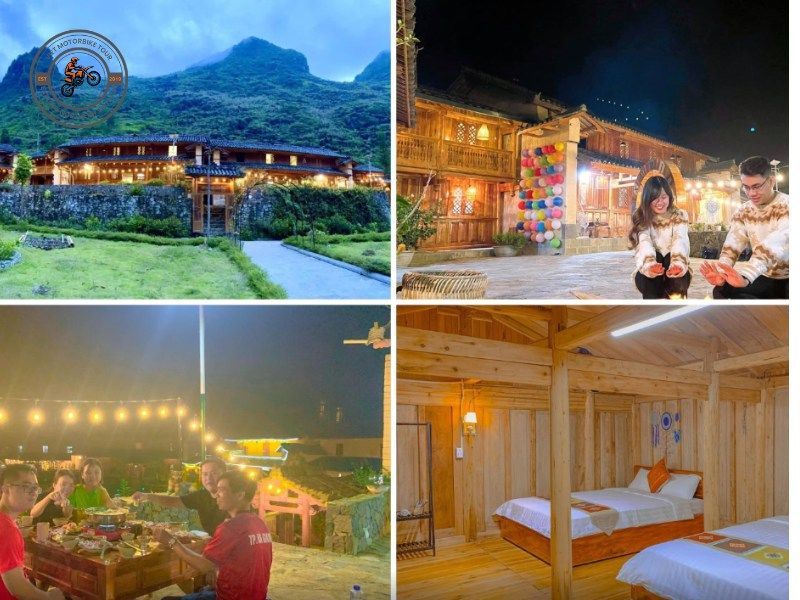
Top 10 After-Dark Activities in Ha Giang for Adventure Travelers
Ha Giang nightlife centers on 10 core activities falling across four categories street food and dining, bars and social venues, cultural experiences, and natural atmosphere spread across the full loop from Ha Giang City to Dong Van, Meo Vac, and Du Gia.
The below each activity to its location, category, and estimated cost use it as a planning reference before diving into the detail for each.
1. Wander Dong Van Ancient Town
Dong Van Ancient Town is the single most atmospheric nightlife destination on the entire Ha Giang Loop a 200-year-old quarter of stone houses, lantern-lit alleys, and highland street vendors that reaches its most compelling state after the sun disappears behind the Ma Pi Leng range. The Old Quarter’s narrow lanes glow amber under paper lanterns, the carved wooden facades of Yao and H’Mong merchant houses take on depth and shadow, and the scent of grilling skewers drifts between the stone walls from vendors who set up only after dark.
The area rewards slow movement. Key stops within the quarter include the main stone-paved alley for lantern photography, Pho Co Dong Van café for tea with a rooftop view across the old tiles, and the street food cluster near the old market gate where locals rather than tourists tend to gather. The Old Quarter winds down around 10–10:30 PM on weekdays and closer to 11 PM on weekends — arrive by 8 PM to absorb the full atmosphere before the stalls pack up.
2. Ha Giang Night Market and Street Food
Ha Giang’s night food scene divides into two primary hubs Ha Giang City for variety and volume, Dong Van for atmosphere and local character — and both reward grazing across multiple stalls over a single sit-down meal.
In Ha Giang City, the main food clusters run along Lý Tự Trọng Street and the riverside lanes. Ngân Hà is the most consistently recommended spot for ấu tẩu congee — the aconite root gives the broth a faint, deliberate bitterness that balances the soft pork trotters. Anh Xuân’s stall handles evening snacks: thắng dền, grilled skewers, seasonal highland produce. The 320 Lý Tự Trọng grill does charcoal meats and vegetables in an open-air setup typical of northern highland evenings. In Dong Van, Mộc Miên Congee near the petrol station is the local insider pick — smaller, quieter, and almost entirely off the tourist radar. Budget 50,000–150,000 VND per person for a full evening of street food across both cities.
3. Rooftop Bars & Pubs
Ha Giang City holds the loop’s most developed bar scene, concentrated in a small cluster of venues that mix quality drinks with genuine highland character. Four stand out, each suited to a different evening mood.
Chill Bro Lounge operates from a wide rooftop terrace with a full-city panorama, a professional bar team, cocktails, craft beer, and weekend live music the best choice for a social evening with a group, running 80,000–220,000 VND per drink. Top of the Loop Rooftop Bar & Restaurant sits at a slightly higher elevation with broader views and a more restaurant-forward menu, better suited for dinner that transitions naturally into drinks. Café Núi Cấm is not a bar in the strict sense it’s a heritage-style café on the slope of Cấm Mountain, best visited at dusk to watch the city shift from pink twilight into electric light, with coffee and tea from 30,000–60,000 VND. Mota Pub, Linh Bar & Coffee, and Pao Town operate at street level with a more backpacker-social dynamic informal, beer-and-spirits menus, good for meeting other loop riders after a long day on the passes.
4. Campfire & Folk Music at Homestay
The campfire at a highland homestay is the most culturally significant after-dark experience on the Ha Giang Loop — and consistently the one travelers remember longest. At participating homestays scattered across the loop, the post-dinner hour centers on an outdoor fire where guests, the host family, and sometimes neighboring locals gather in a circle under open sky.
What unfolds around that fire is not staged. The host family begins with folk songs from the Tây Bắc tradition H’Mong or Dao melodies passed down through generations and the gathering builds naturally from there: shared stories about the passes, about highland life, about the history of specific villages along the route. The gaps between songs and conversation carry a particular quality of mountain silence wind in surrounding trees, the occasional animal sound from the dark beyond the fire’s reach that no bar or restaurant on the loop comes close to replicating.
5. Happy Water Ritual with Local Hosts
“Happy Water” rượu ngô, corn-distilled highland wine is Ha Giang’s social currency after dark, and the ritual surrounding the first shared glass is a genuine cultural moment rather than a tourist experience. At most homestays along the loop, the evening meal opens with the host raising a small ceramic cup, the table calling “một hai ba dzo!”, and the first round going down together as a collective gesture of welcome and inclusion.
The wine itself ranges from pleasantly smooth at quality homestays properly fermented, aged in clay jars, with a clean finish and mild sweetness to aggressively strong at others. It typically runs 30–45% ABV, stronger than it tastes at altitude. Joining the first round signals respect to the host family even if you moderate afterward; most hosts respond warmly to a firm but friendly indication that one round is enough, especially when an early departure is mentioned. For travelers who don’t drink, holding the cup through the toast while not consuming is understood and accepted in most highland households.
6. 26/3 Square Evening Walk
26/3 Square is Ha Giang City’s public commons a 3,000 m² open plaza that becomes the city’s social center after nightfall, filling with local families on evening walks, children running circuits, and vendors selling snacks along the perimeter. The square functions as the most accessible introduction to everyday highland urban life for travelers arriving on their first night in Ha Giang, offering a grounded, unhurried alternative to heading straight to a bar.
On weekend evenings, the square occasionally hosts community events, local festivals, or outdoor performances tied to regional holidays. Electric go-karts run circuits for 15,000 VND per 10 minutes a favorite with local children and, reliably, with adult travelers who try them. The atmosphere peaks between 7:30 and 9:30 PM; after that, the square gradually empties as Ha Giang City’s relatively early nightlife rhythm winds down.
7. Riverside Coffee & Lo River Stroll
The Lo River waterfront in Ha Giang City offers the most relaxed version of the city’s after-dark character a stretch of low-lit riverside cafés, plastic-chair eateries, and open-air tables where locals unwind after work and travelers decompress after their first day on the loop. The water reflects the city lights in a way that makes the scene feel considerably more atmospheric than the modest infrastructure would suggest.
This stretch works best as a transitional activity: a slow coffee or cold beer between dinner and bed, or a quiet first stop before heading to a rooftop bar. Most riverside establishments serve until 10–10:30 PM. The walk itself from the bridge near the city center down toward the quieter southern stretch takes about 20 minutes at a comfortable pace and requires no planning beyond showing up.
8. Meo Vac Weekend Street Scene
Meo Vac delivers the most authentically local nightlife experience on the loop not because it has bars or markets, but because its small-town weekend energy is entirely shaped by residents rather than tourism infrastructure. On Friday and Saturday evenings, the main street and the area around the central market fill with local families, groups of young H’Mong and Dao residents, food vendors, and the occasional traveling trader who has come in for the weekend market.
The experience here is observation rather than participation in any structured sense: watching a highland town go about its social evening, eating at a local restaurant where the menu is likely handwritten and possibly not in English, and absorbing a pace of life that the loop’s more tourist-developed stops no longer fully offer. Meo Vac is also the access point for evening views over the Nho Que River gorge visible from the road above town at dusk, and worth the short detour before the light disappears entirely.
9. Du Gia Village Dusk & Karaoke Homestay
Du Gia sits in a river valley off the main loop circuit, and its nighttime character is the quietest of any overnight stop — defined almost entirely by the homestay rather than the town. The village itself has minimal commercial activity after dark; what it offers instead is an immersive encounter with the physical environment: the sound of the Du Gia River, terraced fields receding into shadow at dusk, and a sky that begins to show stars while the horizon still holds color.
Inside the homestay, the evening typically unfolds through a communal dinner followed by informal karaoke — a fixture of social life across rural northern Vietnam that surprises many travelers with its genuine inclusiveness. Hosts and guests take turns with the microphone regardless of skill level, the song selection runs from Vietnamese pop to regional folk, and the atmosphere is consistently warm. For travelers accustomed to urban nightlife, Du Gia’s version of an evening out recalibrates the definition in a way that tends to stick.
10. Stargazing on the Rocky Plateau
Stargazing on the Dong Van Karst Plateau is available to any traveler who is willing to walk ten minutes from their accommodation and look up — and it consistently ranks among the most unexpectedly affecting experiences on the loop. The plateau sits between 1,000 and 1,600 meters elevation with no significant urban light pollution within 80 kilometers, producing a night sky of a clarity that most travelers from mid-sized cities have never encountered.
The three best locations for unobstructed sky views are Lung Cu (1,470m, open horizon in all directions, minimal artificial light), the fields immediately outside Dong Van town (accessible on foot, full sky exposure within a 10-minute walk from the Old Quarter), and the Nho Que River Valley below Ma Pi Leng (deep natural darkness amplified by the gorge walls). November is the peak month: dry-season air sharpens visibility, temperatures drop enough to make the sky particularly clear, and the Leonid meteor shower in mid-November adds periodic streaks across the plateau. No equipment is needed a clear night, a flat surface to lie on, and 20 minutes away from any light source is sufficient.
Best Time of Year for Ha Giang Nightlife
September through November is the optimal window for Ha Giang nightlife, combining the best weather conditions with the most visually striking evening atmosphere.
Specific seasonal breakdown:
- October–November (Peak): Buckwheat flowers bloom across the Dong Van Plateau, turning the approach roads into pink corridors that look most dramatic at dusk. Night temperatures sit between 12–18°C in Dong Van — cool enough for atmosphere, comfortable enough for outdoor evenings. Skies are typically clear, enabling stargazing
- September: Slightly warmer, rice terraces at their greenest. Fewer tourists than October, which translates to more intimate homestay evenings
- December–February: Cold, occasionally foggy. Evening outdoor activities become uncomfortable above 1,000m. Campfire culture intensifies but bar and market scenes contract significantly
- March–May: Pleasant temperatures, good visibility. Rapeseed and plum blossoms add color to evening walks. Second-best window after autumn
- June–August: Rainy season. Road conditions deteriorate, evening outdoor activities are limited, and the loop’s mountain passes can be genuinely dangerous after dark in heavy rain
If this is your first visit to Ha Giang, booking a guided tour is the smartest way to experience the nightlife safely and fully. Ha Giang after dark rewards those who know where to look a vivid night market, highland street food worth seeking out, and cafes and bars perched above river valleys with views that daylight cannot replicate. Navigating all of this without local knowledge means missing the spots that matter and spending time on the ones that don’t.
Viet Motorbike Tour connects first-time and returning visitors with experienced local guides who know the loop’s evening scene from the inside which street food stalls locals actually eat at, which bars carry the right atmosphere, and which homestay fires are worth staying up for. Every itinerary is built around a complete Ha Giang night experience: efficient, well-paced, and grounded in genuine local insight.
Book your tour with Viet Motorbike Tour and discover Ha Giang at night the way it deserves to be explored.