 Home
Home About
About Tours
Tours Bikes Rental
 Contact
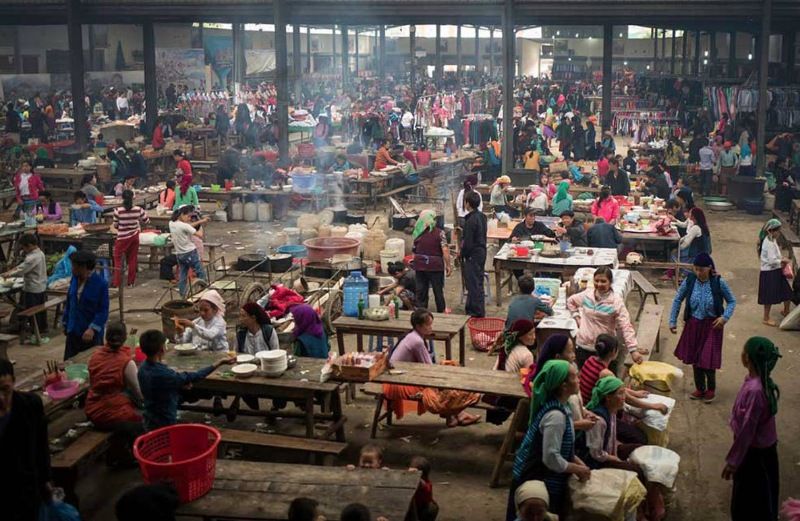
Meo Vac Market is the largest periodic market in Ha Giang province, held every Sunday morning in the center of Meo Vac town, drawing over 14 ethnic minority groups and hundreds of visitors who come to trade, connect, and immerse themselves in a deeply authentic highland culture. Remarkably, this is far more than a place to exchange goods Meo Vac Market is a living cultural festival, where the vibrant costumes of the H’Mong, Dao, Tay, and Lo Lo people blend with the sound of livestock bells and the aroma of thang co simmering over open fires on the rocky plateau.
Below, this guide will walk you through everything you need to know before stepping foot into this extraordinary market.
Meo Vac Market Cultural Identity
Meo Vac Market is a large periodic highland market the largest in Ha Giang province held every Sunday in the town center of Meo Vac, where more than 14 ethnic minority groups gather to trade, celebrate, and preserve centuries-old cultural traditions on the Dong Van Rocky Plateau.
To understand what makes it truly special, the distinction lies in what this market represents beyond commerce. Unlike an ordinary daily market, Meo Vac operates as both a trading hub and a weekly cultural gathering a rare living space where H’Mong, Dao, Tay, Lo Lo, Giay, and Nung people descend from distant mountain villages not just to buy and sell, but to reconnect, share stories, and keep alive the customs passed down through generations.
The market is divided into distinct zones organized by product category from the bustling outdoor cattle market in the northern section, to the covered indoor market filled with daily essentials, to the open-air stalls overflowing with brocade textiles, traditional silver jewelry, and highland street food. Each zone carries its own rhythm, its own energy, and its own story — together forming a cultural panorama that no other market on the Rocky Plateau can fully replicate.
It is no coincidence that many cultural researchers refer to Meo Vac Market as a “living museum” of Vietnam’s northernmost borderland. Every market session is an open book on the daily life, customs, languages, and clothing of the region’s ethnic peoples — something no exhibition hall or printed volume can convey as powerfully as standing in the middle of that swirling crowd, wrapped in color and sound and mountain mist.
Meo Vac Market Schedule: Opening Day and Hours
Meo Vac Market opens every Sunday, starting from approximately 4–5 AM and continuing until 4 PM, with the golden window from 7 AM to 11 AM offering the most crowded, lively, and experience-rich atmosphere of the entire session.
To help you plan effectively, the following sections break down the essential logistical details — location, directions, and transportation options — that every visitor needs before making the trip.
Location and Accessibility of Meo Vac Market
Meo Vac Market sits in the heart of Meo Vac town, Meo Vac District, Ha Giang Province — a highly accessible location just a short walk from the district stadium and approximately 10 minutes on foot from the historic Chung Pua ancient house.
Specifically, once you reach the town center of Meo Vac, finding the market requires almost no effort — simply follow the rising noise, the flashes of color, and the drifting aroma of food cooking over open flames from the early morning hours. This central positioning is one of the market’s most practical advantages: it is easily reachable by both motorbike and car without navigating complex mountain passes.
The main road routes leading to the market include:
- Route QL34 → TL176 → DT182: Follow the road to the Meo Vac town health station, turn right, and continue approximately 850 meters to reach the market.
- Route from Dong Van: Take QL4C approximately 20km southward, heading straight into the town center.
- Route from Ha Giang City: Follow QL34 for approximately 150km, with a travel time of 4–5 hours depending on the vehicle and road conditions.
Transportation Options from Hanoi to Meo Vac Market
There are 3 primary transportation options for traveling from Hanoi to Meo Vac Market: an overnight direct bus, a self-guided motorbike journey along the scenic highland route, or a combination of a bus to Ha Giang City followed by a connecting bus or motorbike to Meo Vac.
Below is a comparison table summarizing all three options across key criteria — distance, travel time, estimated cost, and best-fit traveler type — to help you choose the most suitable approach for your itinerary.
| Transportation | Distance | Travel Time | Estimated Cost | Best For |
|---|---|---|---|---|
| Overnight bus (My Dinh → Meo Vac) | ~500km | 10–11 hours | 400,000–500,000 VND/person | Budget travelers, solo visitors without a vehicle |
| Self-guided motorbike | ~500km | 1–2 days | Fuel + food and accommodation en route | Adventure travelers, backpackers |
| Bus to Ha Giang + connecting transport | ~350km + 150km | 7–8h + 5h | 200,000đ + 120,000–150,000đ | Those who want to rest in Ha Giang first |
Key Zones Inside Meo Vac Market
Inside Meo Vac Market there are 3 main zones: the outdoor livestock market in the northern section, the covered indoor market for daily goods, and the open-air zone featuring brocade textiles, street food, and traditional silver crafts — each offering a completely distinct atmosphere and set of experiences.
Let’s explore each zone in detail so you know exactly where to begin your visit and what to look for in every corner of this remarkable market.
The Livestock Market
The livestock section of Meo Vac Market is the largest cattle trading hub on the Dong Van Rocky Plateau, located in the northern part of the market grounds, where the sight of buffalo, cattle, pigs, and goats being led through mountain passes before dawn creates one of the most raw, visually striking scenes in the entire highland region.
Specifically, this is something very few markets in Vietnam have managed to preserve in such an authentic and unfiltered form. Long before sunrise, H’Mong and Dao men dressed in traditional attire guide their livestock down winding stone paths, their animals adorned with bells that echo across the valleys below. The livestock zone is not merely a place of economic exchange it is a public space where family reputation, community trust, and generational knowledge of animal husbandry are openly displayed and respected.
For travelers and photographers, the livestock zone offers the most visually powerful shots of the entire market morning light filtering through highland mist, the deep tones of traditional clothing against the raw grey of the plateau stone, and the unscripted energy of real highland life unfolding in real time.
Goods and Products Available
Meo Vac Market sells 5 main categories of products: fresh agricultural produce, traditional brocade textiles and ethnic clothing, handcrafted silver jewelry, daily household tools and goods, and locally harvested medicinal herbs — the vast majority produced, grown, or gathered by the ethnic communities themselves.
For example, stepping into the brocade textile section feels like entering a living gallery. H’Mong women in their finest pleated skirts sit behind displays of hand-loomed linen fabric decorated with intricate geometric motifs passed down through families for generations. These are not mass-produced souvenirs — they are wearable cultural artifacts. Nearby, the silver jewelry stalls offer hand-engraved bangles, necklaces, and rings, each carrying distinct design signatures that identify the ethnic group of its maker.
Must-Try Local Specialties at Meo Vac Market
There are 6 essential specialties to try and bring home from Meo Vac Market: traditional thang co stew, au tau porridge, corn cake, forest-herb corn wine, smoked buffalo meat, and buckwheat honey — each carrying a distinct flavor profile rooted in the highland culture of the Dong Van Rocky Plateau that simply cannot be replicated elsewhere.
Furthermore, the food experience at Meo Vac Market is not just about taste — it is one of the most direct ways to understand the daily life, culinary philosophy, and resourcefulness of the 14+ ethnic groups who have called this plateau home for centuries.
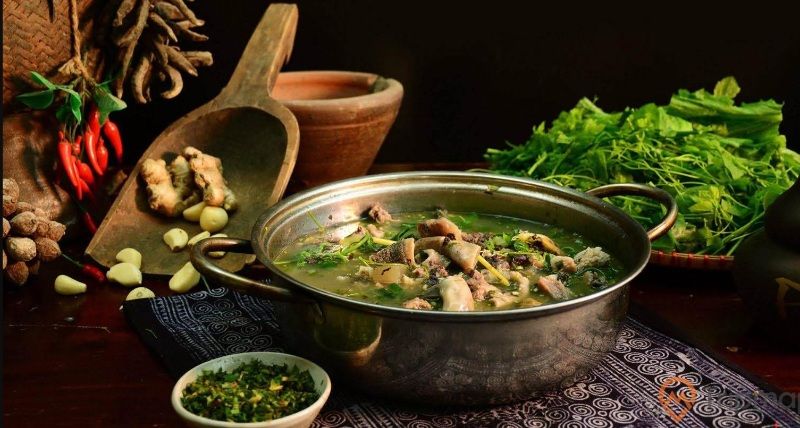
- Thang co is the undisputed signature dish of Meo Vac Market. The pot — filled with horse or buffalo meat, organs, and over 12 native spices including cardamom, star anise, cinnamon, and ginger — simmers over a wood fire for hours, sending thick white steam curling into the morning mist. You don’t need to search for the best stall; simply follow the smoke and you’ll find it.
- Au tau porridge is a lesser-known but deeply memorable specialty — made from the au tau tuber, a highland medicinal plant, this porridge carries a subtly bitter and sweet flavor that the H’Mong people have long used to ward off mountain cold. A warm bowl of au tau porridge at dawn, surrounded by mist and the sounds of the waking market, is an experience that stays with you long after you leave.
- Forest-herb corn wine is a cornerstone of every market day transaction. Distilled using traditional methods with yeast derived from wild forest leaves, Meo Vac corn wine is crystal clear, distinctly aromatic, and carries a smooth, sweet finish entirely unlike lowland rice wine. Note: approach this drink with patience — the alcohol content is considerably higher than it appears.
Read more: Top 15 Most Famous Ha Giang Specialties You Must Try Once
For take-home souvenirs, the following items are the most recommended and most beloved among returning visitors:
- Smoked buffalo meat (Thit trau gac bep): Slow-smoked over a wood fire in the traditional highland method, this preserved meat is long-lasting, deeply savory, and carries the unmistakable scent of the mountains — consistently the top souvenir choice among visitors.
- Buckwheat honey: A specialty exclusive to the Dong Van Rocky Plateau, harvested from wild buckwheat flowers growing on the stone terrain, with an unusually fragrant aroma and a distinctive amber color found nowhere else.
- H’Mong hand-loomed brocade: Every piece is a one-of-a-kind handcraft, woven on traditional looms with patterns unique to each family — a meaningful and culturally significant gift.
One essential practical note: Always carry small denomination banknotes to the market. Most vendors do not carry change for large bills. And when bargaining, do so warmly and respectfully — the highland people are sincere traders who value dignity in every exchange.
Complete Travel Tips for Visiting Meo Vac Market
To get the most out of Meo Vac Market, you need to wake up by 4–5 AM, carry small bills and wear warm layers, dedicate 3–4 hours to the golden window of 7–11 AM, and plan a combined Rocky Plateau itinerary to make full use of the day.
Next, here is a complete collection of practical travel tips drawn from experienced travelers who have attended multiple sessions of this market — covering everything from timing and packing to route planning and cultural etiquette.
Combining Meo Vac Market with Rocky Plateau Highlights
Combining Meo Vac Market with at least 2–3 other destinations on the Dong Van Rocky Plateau in a single Sunday is absolutely worthwhile — the market wraps up by 11–12 PM, leaving an entire afternoon free to explore Ma Pi Leng Pass, Nho Que River, and several other landmark sites all within a 30–40 minute motorbike ride from the market.
Specifically, here is a suggested itinerary for a perfect Sunday in Meo Vac:
- 4:30–5:00 AM: Wake up, have a light breakfast at your guesthouse, and head to the market.
- 5:00–7:00 AM: Explore the livestock zone — the quietest and most photogenic window of the morning.
- 7:00–10:30 AM: Walk through all market zones, eat thang co, shop for souvenirs and local specialties.
- 10:30–11:00 AM: Wrap up at the market and prepare your motorbike for departure.
- 11:30 AM–1:00 PM: Ride to Ma Pi Leng Pass (~20km), stop at the panoramic viewpoint for photos and fresh mountain air.
- 1:00–2:30 PM: Have lunch along the route or back in Meo Vac town before continuing.
- 2:30–4:30 PM: Descend to Nho Que River for a kayak experience or elevated viewpoint, then visit Lo Lo Chai Village if time allows.
Safety reminder: The mountain roads of the Rocky Plateau are steep and winding. Always ensure your motorbike has sufficient fuel and functioning brakes, and maintain a cautious speed throughout.
Best Time of Year to Visit Meo Vac Market
Meo Vac Market is most vibrant in winter — particularly from November through January, in the weeks before and after Lunar New Year when local families stock up on livestock, food, and supplies for the new year, creating the busiest, most emotionally rich market atmosphere of the entire annual cycle.
However, every season brings a distinct character and experience to Meo Vac:
- October–November (Buckwheat flower season): The plateau is blanketed in pink-purple buckwheat blossoms the most visually stunning time of year, though also the peak tourist season. Book accommodation at least 2–3 weeks in advance.
- December–January (Winter): The plateau drifts in and out of mist and fog, lending the market an otherworldly atmosphere. The most emotionally warm and culturally authentic version of the market experience.
- March–April (Peach and plum blossom season): Fresh, mild weather with moderate visitor numbers — ideal for families or small groups seeking a relaxed pace.
- June–August (Summer): The highland turns lush and green with terraced rice fields; rainfall is common but the scenery is beautiful, and the market remains active with mainly local visitors.
Bottom line: There is no wrong season to visit Meo Vac Market. The only non-negotiable condition is arriving on a Sunday morning — that is the one rule that makes or breaks the entire experience.
Meo Vac Market vs. Other Highland Markets on the Dong Van Rocky Plateau
Meo Vac Market leads in scale and frequency (weekly, largest in Ha Giang), Khau Vai Love Market excels in cultural uniqueness and emotional depth (once a year on the lunar calendar), Dong Van Market stands out for its ancient town atmosphere and historical setting, while smaller markets like Niem Son and Son Vi offer quieter, more intimate and local-focused experiences.
Notably, understanding the differences between these markets will help you design a smarter, more culturally layered itinerary — rather than visiting just one market, you can strategically combine several within the same trip to capture the full spectrum of highland market culture.
Khau Vai Love Market and Meo Vac Market
Khau Vai Love Market differs from Meo Vac Market in 3 fundamental ways: frequency (once a year vs. every week), core purpose (a festival of love and reunion vs. a regular trading and community gathering), and the nature of participation (people reuniting with former lovers vs. families coming to buy, sell, and socialize).
More specifically, the Khau Vai Love Market also known as the Phong Luu Market takes place only once annually on the 27th day of the third lunar month. It is a deeply intimate and emotionally charged occasion where couples who loved each other but could not marry due to family traditions or social customs are permitted to meet again, just once a year, to revisit shared memories. This is an utterly unique cultural tradition with no equivalent anywhere else in the world.
By contrast, Meo Vac Market is accessible and practical open every single Sunday of the year, no special date required. This is its defining advantage over Khau Vai for most travelers planning a standard highland itinerary.
In short: If your visit happens to fall on the 27th day of the third lunar month, do not miss Khau Vai Love Market. For any other Sunday of the year, Meo Vac Market remains the irreplaceable choice.
Meo Vac Market as a Living Museum of Highland Culture
Meo Vac Market genuinely functions as a living museum of highland ethnic culture for at least 3 compelling reasons: it is the only space where 14+ ethnic minority groups gather weekly in full traditional dress; it is a place where language, artisanal craftsmanship, and trading customs are actively practiced — not merely displayed; and it exists within the boundaries of the UNESCO Global Geopark of Dong Van Rocky Plateau, embedding it within a globally recognized landscape of outstanding natural and cultural heritage.
In contrast to a conventional museum where everything is labeled, sealed behind glass, and preserved in silence — Meo Vac Market is loud, layered, fragrant, and constantly in motion. It changes with the seasons, with family circumstances, with harvests and festivals. That is precisely what gives it irreplaceable cultural value: you do not come to observe a frozen past, but to participate in the living present of a civilization that has endured for centuries on one of the world’s most extreme terrains.
The market’s position within the Dong Van Karst Plateau UNESCO Global Geopark recognized in 2010 and successfully re-evaluated in subsequent review cycles — further elevates its significance. This designation affirms that the cultural practices sustained within this landscape, including the weekly gathering of the market itself, are considered an inseparable part of a living world heritage.