
 Home
Home About
About Tours
Tours Bikes Rental
 Contact
Planning a motorbike tour in Northern Vietnam and not sure where to start? Northern Vietnam is home to some of the most dramatic riding terrain in Southeast Asia limestone canyons, terraced mountain passes, remote ethnic villages, and roads that no bus or car itinerary can reach. But with dozens of circuits, operators, and duration options on the market, choosing the right tour is harder than it looks.
In this guide, Viet Motorbike Tour break down the top 10 motorbike tours in Northern Vietnam by route, difficulty, duration, and cost so you can compare, decide, and ride with confidence.
What Makes Motorbike Tours in Northern Vietnam Different from Regular Travel?
Three defining characteristics separate a northern Vietnam motorbike tour from conventional travel in the region:
1. Access to genuinely remote terrain. The Ha Giang Loop’s Ma Pi Leng Pass sits at 1,600 metres above a sheer canyon. Mu Cang Chai’s terraced rice fields unfurl across hillsides connected only by narrow switchback roads. Ba Be Lake in Bac Kan province sits inside a national park where motorised vehicles other than motorbikes and small boats are largely absent. These destinations exist on two wheels or not at all.
2. Pace and autonomy. A motorbike tour even a guided one allows riders to stop for photographs, pull into a roadside market, or linger in a Hmong village for lunch. The pace is human-scale. Guides can reroute around road damage, seek out a better viewpoint, or extend a riding day based on conditions. A bus cannot do this.
3. Cultural proximity. Riding through northern Vietnam’s highlands means passing through daily life farmers guiding water buffalo along terraced fields, women in Red Dao embroidered headscarves carrying firewood, children waving from roadside schools. This proximity is the product of the motorbike’s scale and quietness compared to a four-wheeled vehicle.
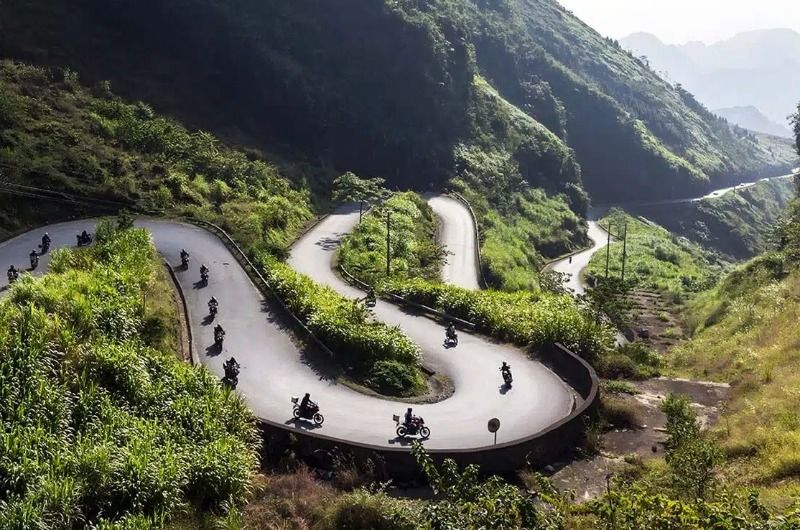
Top 10 Northern Vietnam Motorbike Tours for Adventure Riders in 2026
1. Ha Giang Loop Motorbike Tour
The Ha Giang Loop is the single most celebrated motorbike circuit in northern Vietnam, covering approximately 350 kilometres in a circuit from Ha Giang city through Dong Van, Meo Vac, and back via Ma Pi Leng Pass one of Asia’s most visually dramatic mountain roads. The route passes through the Dong Van Karst Plateau Geopark, recognised by UNESCO’s Global Geoparks Network, where limestone towers rise above deep river canyons and the turquoise Nho Que River carves a line between sheer cliffs.
Route: Hanoi → Ha Giang city (overnight) → Yen Minh → Dong Van → Meo Vac → Ma Pi Leng Pass → Meo Vac → Ha Giang → Hanoi. Total riding distance from Ha Giang city: approximately 350 km over 3–4 days of active riding.
Key highlights:
- Ma Pi Leng Pass — the most technically exposed section of the loop, where the road runs along a cliff-face above a 700-metre canyon. Paved but narrow, with sheer drops and no barriers on sections.
- Dong Van Old Quarter — a preserved French-colonial and Chinese architectural cluster at 1,400 metres altitude, home to several H’mong and Tay ethnic groups.
- Nho Que River viewpoints — multiple lookout points above the river valley, most famously the bend below Ma Pi Leng that is one of the most photographed landscapes in Vietnam.
- Highland markets — Dong Van Sunday market and Meo Vac Saturday market offer immersive encounters with H’mong, Tay, Nung, and Lo Lo ethnic communities in traditional dress.
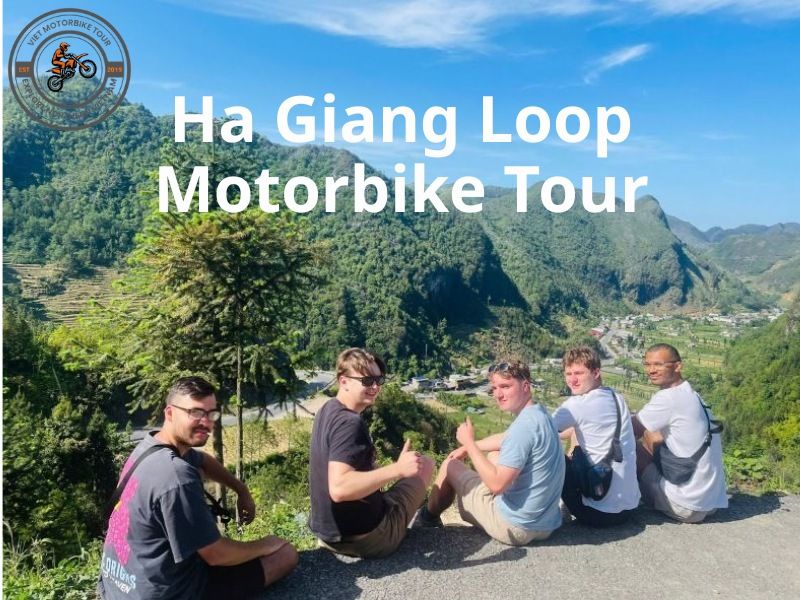
2. Northwest Loop (Sapa, Mu Cang Chai)
The Northwest Loop is northern Vietnam’s second great motorbike circuit, sweeping west from Hanoi through the provinces of Hoa Binh, Son La, Lai Chau, and Lao Cai before returning via Sapa and Bac Ha. Where Ha Giang is defined by limestone and canyon, the Northwest is defined by layered rice terraces and high alpine passes — most famously O Quy Ho Pass (1,900 metres, the highest paved pass in Vietnam) and the terraced valleys of Mu Cang Chai, which are at their most spectacular during the golden harvest season in September and October.
Route: Hanoi → Mai Chau → Moc Chau → Yen Bai → Mu Cang Chai → Nghia Lo → Lai Chau → Sapa → Bac Ha → return to Hanoi. Total circuit: approximately 1,400–1,600 km over 7–9 riding days.
Key highlights:
- Mu Cang Chai terraced rice fields — listed as a National Scenic Relic by Vietnam’s Ministry of Culture, these cascading terraces are arguably the most photographed landscape in northern Vietnam. Peak visit window: late September to mid-October (golden rice season).
- O Quy Ho Pass — the longest and highest paved pass in northern Vietnam, connecting Lai Chau province to Sapa with 50+ hairpin turns and panoramic views above the cloud line.
- Bac Ha Sunday Market — one of the most vibrant highland markets in the north, where Flower H’mong women arrive in elaborately embroidered full-colour costumes.
- Dien Bien Phu (extended variant) — for riders with 9–10 days, the route extends to Dien Bien Phu, site of the 1954 battle that ended French Indochina, adding significant historical depth to the cultural layer of the tour.
3. Full Northern Loop (Ha Giang + Cao Bang + Ba Be)
The Full Northern Loop is the most geographically comprehensive standard circuit in northern Vietnam, combining the three major riding regions — the karst mountains of Ha Giang, the limestone valleys of Cao Bang, and the forested lake district of Ba Be — into a single 10–12 day circuit of approximately 1,800–2,000 km.
Route: Hanoi → Ba Be National Park → Cao Bang → Ban Gioc Waterfall → Ha Giang Loop (Dong Van, Meo Vac, Ma Pi Leng) → Sapa → Bac Ha → Hanoi. Daily distances average 160–200 km.
Key highlights:
- Ban Gioc Waterfall (Cao Bang) — one of Southeast Asia’s largest waterfalls, straddling the Vietnam–China border. The approach road through Cao Bang province offers some of the most remote and least-trafficked riding in northern Vietnam.
- Ba Be National Park — Vietnam’s largest freshwater lake system, surrounded by primary forest. A boat section through the lake district is typically included as a rest day on longer tours.
- Northeast ethnic diversity — Cao Bang and Bac Kan provinces are home to Tay, Nung, and Dao communities rarely encountered on the more tourist-frequented Ha Giang circuit.
4. Grand Northern Expedition
The Grand Northern Expedition is northern Vietnam’s most comprehensive motorbike journey: a 15-day, 2,000+ km circuit that combines all four major northern circuits — Ha Giang, Cao Bang–Ba Be, Northwest (Mu Cang Chai–Sapa), and the Dien Bien Phu historical extension — into a single continuous ride. This is the tour that operators such as Vietnam Motorbike Tour Expert describe as their flagship “fully grand and incredible” northern experience.
Route: Hanoi → Hoa Binh → Mai Chau → Moc Chau → Son La → Dien Bien Phu → Lai Chau → Sapa → Bac Ha → Mu Cang Chai → Ha Giang Loop → Cao Bang → Ban Gioc → Ba Be → Hanoi. Total distance: 2,000–2,400 km across 13–14 riding days, with 1–2 rest days built in.
Key highlights: Every major landmark of northern Vietnam: O Quy Ho Pass, Mu Cang Chai golden terraces, Dien Bien Phu battlefields, Ha Giang Loop and Ma Pi Leng Pass, Ban Gioc Waterfall, Ba Be National Park, and multiple highland markets (Bac Ha, Dong Van, Can Cau).
5. Hanoi to Mai Chau Weekend Ride
The Hanoi to Mai Chau Weekend Ride is northern Vietnam’s definitive entry-level motorbike tour a two-day circuit that delivers genuine mountain scenery, a White Thai minority valley, and one of the north’s most rewarding mountain passes (Thung Khe Pass, 960 metres) without demanding advanced riding skills or more than a weekend of time. It is the most popular “first ride” itinerary among international travellers new to motorbike travel in Vietnam, and the most commonly recommended circuit by Hanoi-based operators for riders with limited or no prior mountain experience.
Route: Hanoi → Hoa Binh → Thung Khe Pass (Moc Chau direction turn-off) → Mai Chau Valley → overnight homestay → Mai Chau → return to Hanoi via Highway 6. Total round-trip distance: approximately 320–350 km, split across two days of 160–175 km each.
Key highlights:
- Thung Khe Pass (960 m) — the only significant mountain section of the entire route, a series of well-maintained switchbacks with wide road surface, low traffic, and panoramic views over forested valley. Manageable for beginners on semi-automatic bikes; provides a meaningful “first mountain pass” experience without the exposure risks of Ha Giang or Sapa circuits.
- Mai Chau Valley — a broad, flat-floored valley ringed by limestone hills, home to White Thai (Thai Trang) minority villages. Homestay accommodation in traditional stilt-house longhouses is the standard overnight format; families serve home-cooked meals including sticky rice, grilled pork, and local rice wine. The valley is quiet, green, and visually distinct from the more dramatic landscapes of the far north.
- Hoa Binh Reservoir — the ride from Hanoi passes alongside the Hoa Binh hydroelectric reservoir, with optional stops at viewpoints above the water. Several operators include a short boat section on the reservoir as an optional add-on for riders wanting a rest from the saddle.
- Lac Village and Pom Coong Village — two White Thai villages in Mai Chau Valley accessible by bicycle from the homestay, both active farming communities with weaving workshops producing traditional hand-loomed textiles.
6. Ninh Binh Day Loop from Hanoi
The Ninh Binh Day Loop is northern Vietnam’s most accessible motorbike experience: a 90-kilometre one-way ride south of Hanoi through flat riverside roads to Vietnam’s most striking inland karst landscape — a destination that many riders describe as “Ha Long Bay on land.” This is the standard first-day ride offered by Hanoi motorbike tour operators to guests who want to experience Vietnamese roads before committing to a multi-day circuit.
Route: Hanoi → Highway 1A south → Ninh Binh city → Tam Coc boat gorge → Bich Dong Pagoda → Mua Cave viewpoint → Hoa Lu ancient capital → return to Hanoi. Total distance: approximately 180–200 km round trip. Riding time: 3.5–4.5 hours total, with 4–5 hours of sightseeing time at stops.
Key highlights:
- Tam Coc boat gorge — three river caves carved through limestone karst, navigated by flat-bottomed rowing boat (sampan) for approximately 1.5 hours. The boat journey through the cave tunnels and rice paddy landscape is one of the most photographed experiences in northern Vietnam.
- Mua Cave viewpoint — a 500-step climb up a limestone hill above the Tam Coc valley delivers the panoramic viewpoint most associated with Ninh Binh in travel photography. The view encompasses the river meanders and karst peaks that define the landscape.
- Bich Dong Pagoda — a 15th-century Buddhist temple complex built into the face of a limestone cliff, accessible by a short path through tropical forest. One of the best-preserved pagoda complexes in northern Vietnam.
- Hoa Lu ancient capital — the site of Vietnam’s 10th-century Dinh and Le dynasty capitals, with two well-preserved temple complexes in an enclosed limestone valley. Provides historical depth to the day trip.
7. Northwest Off-Road Dirt Bike Tour (Ta Xua, Ngoc Chien)
The Northwest Off-Road Dirt Bike Tour is the most technically demanding circuit in northern Vietnam’s standard tour catalogue — an 8-day ride that leaves paved roads behind from Day 2 and does not return to consistent asphalt until the final descent toward Hanoi. The core of this tour is a sequence of three off-road destinations that sit entirely outside the experience of standard paved-road tour riders: Ta Xua Mountain (the “Dinosaur Backbone” ridge at 2,865 metres), Ngoc Chien Valley (a remote Muong La village famous for natural hot springs), and the Mu Cang Chai terraced plateau approached via dirt trails rather than Highway 32.
Route: Hanoi → Mai Chau → Ta Xua Peak → Mu Cang Chai (dirt trail descent) → Ngoc Chien (via river-valley track) → Muong La hot springs → Son La → Tuan Giao → Dien Bien Phu → Lai Chau → Sapa → Thac Ba Lake → Hanoi. Total distance: approximately 1,400–1,600 km with 40–50% off-road or rough-surface riding.
Key highlights:
- Ta Xua “Dinosaur Backbone” ridge — a narrow, exposed ridge trail at 2,865 metres elevation that riders describe as one of Vietnam’s most dramatic off-road sections. On clear mornings, the ridge sits above a sea of cloud, with limestone peaks visible in all directions. The trail involves steep loose-gravel descents and requires confident off-road bike handling.
- Ngoc Chien natural hot springs — a remote village in the Muong La district accessible via a dirt track through a river valley. The hot spring pools are unmanaged and free — a genuine highlight for riders after consecutive days of technical riding. Local Muong minority homestays offer simple but warm accommodation.
- Mu Cang Chai via dirt approach — arriving at Mu Cang Chai’s terraced valleys via backcountry trails rather than the standard highway delivers a completely different perspective on the landscape. Dirt approaches through Tu Le and La Pan Tan reveal terraces that most highway riders never see.
- Sin Ho remote plateau (extended variant) — some operators include Sin Ho, a remote plateau in Lai Chau Province at 1,500 metres accessible only via a rough mountain track. Sin Ho is home to a primarily H’mong and Dao community with minimal tourist infrastructure, making it one of the most genuinely off-the-beaten-path stops in northern Vietnam.
8. Ha Giang + Cao Bang 5-Day Loop
The Ha Giang + Cao Bang 5-Day Loop is the most efficient circuit for riders who want to combine northern Vietnam’s two most dramatic provinces in a single continuous route — accessing both the karst canyon landscape of Ha Giang and the waterfall-and-limestone scenery of Cao Bang without the 10–12 day commitment of the Full Northern Loop. It is increasingly popular among riders who have already completed the standard Ha Giang Loop and want to extend their northern Vietnam riding with genuinely new terrain.
Route: Hanoi → Ha Giang city → Ha Giang Loop (Ma Pi Leng, Dong Van, Meo Vac) → Bao Lac → Cao Bang → Ban Gioc Waterfall → Cao Bang city → return to Hanoi. Total distance: approximately 900–1,100 km over 4 active riding days (Day 1 transit to Ha Giang by sleeper bus).
Key highlights:
- Ha Giang Loop core section (Days 1–2 of riding): The full Ma Pi Leng, Dong Van, Lung Cu, and Meo Vac circuit, identical to the standard 3–5 day Ha Giang Loop tour described above.
Bao Lac to Cao Bang transition road — the connecting road between Ha Giang’s northern end and Cao Bang province is one of northern Vietnam’s least-known riding routes: narrow, rough-surfaced, and spectacularly scenic through borderland karst. Low tourist traffic makes this section feel genuinely remote even by northern Vietnam standards. - Ban Gioc Waterfall (Cao Bang Province) — one of Southeast Asia’s largest waterfalls at 300 metres wide and 70 metres tall, straddling the Vietnam–China border. The approach road from Cao Bang city passes through Trung Khanh limestone karst country, where isolated farmhouses and traditional Tay villages line a road that sees minimal motorbike tour traffic.
- Nguom Ngao Cave — adjacent to Ban Gioc, this 2.1-kilometre limestone cave system with stalactite formations is included in most 5-day loop itineraries as a half-day cultural stop.
9. Sapa & Y Ty Border Loop
The Sapa & Y Ty Border Loop is a 3-day motorbike circuit that takes riders north from Sapa along the Chinese border road (Provincial Route DT155) to the remote hilltop commune of Y Ty in Bat Xat District, Lao Cai Province — a destination at over 2,000 metres altitude where Red Dao, Ha Nhi, Tay, and Flower H’mong communities live in near-total isolation from mainstream Vietnamese society. This circuit is the closest thing in northern Vietnam to a hybrid trekking-and-riding itinerary, where motorbike access enables trailhead reach and foot travel fills the cultural detail.
Route: Sapa → Lao Chai → Ta Van → Ta Giang Phinh → Y Ty (Day 1 overnight) → Lung Po Flagpole (China border viewpoint) → Ban Pho Village → Can Cau Market (Saturdays) → return to Sapa via O Quy Ho Pass or DT155 (Day 2–3). Total circuit: approximately 200–240 km over 2 active riding days.
Key highlights:
- Y Ty commune — situated at 2,000+ metres near the Vietnam–China border, Y Ty is famous in Vietnam for its “sea of clouds” photography — morning mist fills the valleys below the village platform, creating a landscape that resembles islands floating on white cloud. The terraced rice paddies immediately around the village are among the highest-altitude paddies in Vietnam.
- Lung Po Flagpole — a border marker on the Vietnam–China frontier, reached via a short trail from the road north of Y Ty. The viewpoint delivers panoramic views of both Vietnamese and Chinese territory across the border ridge.
- Ta Giang Phinh and Ban Khoang villages — on the DT155 road between Sapa and Y Ty, these Red Dao and H’mong farming communities are active and unmodified by tourism, with women in traditional embroidered dress visible in daily agricultural work.
- Can Cau Saturday Market — the highland market in Can Cau, approximately 35 km north of Bac Ha, is one of the most ethnically diverse highland markets in northern Vietnam. Flower H’mong, Black H’mong, Phu La, and Tay communities converge weekly. Timing the Y Ty loop to include a Saturday Can Cau visit adds significant cultural value.
10. Full South-to-North Hanoi to Ha Giang via Bac Ha
The Hanoi to Ha Giang via Bac Ha 4-Day Circuit is the most popular independent or semi-guided format for riders who want to ride the Ha Giang Loop without the group tour structure, using the scenic northeast provincial roads through Bac Ha as both the approach and return route. This itinerary is distinct from the standard Ha Giang Loop tour (which uses a sleeper bus from Hanoi to Ha Giang city) in that riders cover the Hanoi–Ha Giang distance by motorbike — adding two full days of mountain riding through Tuyen Quang, Ha Giang province’s outer highlands, and the Bac Ha Sunday market circuit.
Route: Hanoi → Tuyen Quang → Ha Giang city (Day 1, ~240 km) → Ha Giang Loop core: Quan Ba Heaven Gate → Yen Minh → Dong Van → Ma Pi Leng → Meo Vac (Day 2, ~135 km) → Lung Cu Flagpole → Ha Giang city (Day 3, ~180 km) → Bac Ha → Lao Cai → return to Hanoi by overnight train or road (Day 4). Total riding distance: approximately 700–800 km over 4 days of riding.
Key highlights:
- Hanoi to Ha Giang by road (Day 1) — the 240 km ride north from Hanoi through Tuyen Quang and Vinh Phuc provinces passes through largely agricultural lowland-to-highland transition terrain. Not the most dramatic riding day in northern Vietnam, but it gives riders a full acclimatisation day on Vietnamese roads before entering the more technical Ha Giang province. The road through Tuyen Quang includes sections alongside the Gam River that are genuinely scenic.
- Ha Giang Loop (Days 2–3) — the complete standard Ha Giang Loop: Quan Ba Heaven Gate, Bac Sum Pass, H’mong King Palace at Sa Phin, Dong Van Old Quarter, Ma Pi Leng Pass, Meo Vac overlook, Nho Que River canyon, Lung Cu Flagpole. Identical in content to Tour 1, covered in full above.
- Bac Ha Sunday Market (Day 4) — returning to Hanoi via Lao Cai and Bac Ha allows riders to time the final day around Bac Ha’s famous Sunday highland market — one of the largest and most colourful ethnic markets in northern Vietnam, attended by Flower H’mong, Black H’mong, Phu La, Giay, and Tay communities from surrounding villages. Market starts at approximately 6:00 AM and winds down by noon.
- Return flexibility — from Lao Cai, riders can return to Hanoi by overnight train (comfortable, bike transportable with advance booking), by overnight sleeper bus (cheapest option), or by continuing to ride Highway 2 back via Phu Tho (full riding return, an additional riding day).
Type of Motorbike Is Used on Northern Vietnam Tours
The motorbike type used on a northern Vietnam tour matters significantly, it directly affects rider comfort, safety on technical terrain, and the range of routes an operator can offer. There are three main categories of motorbike used across northern Vietnam tours, each matched to a different rider profile and terrain type.
Honda Win (semi-automatic, 100–110cc): The traditional budget tour bike. Semi-automatic gearbox makes it accessible to riders without manual experience. Downsides: underpowered on steep climbs, prone to mechanical issues on longer circuits, limited suspension for rough roads. Suitable for: day trips, 2–3 day paved-road circuits from Hanoi (Ninh Binh, Mai Chau). Not recommended for Ha Giang Loop or Northwest circuits with significant mountain riding.
Honda XR150 / CRF250 / CB190 (manual trail bikes, 150–250cc): The industry standard for guided northern Vietnam tours. These bikes offer sufficient power for all paved mountain passes, basic off-road capability for dirt track sections, and reliable maintenance accessibility across provincial towns. The Honda CRF250 is widely considered the optimal balance of capability, reliability, and repairability for northern Vietnam riding. Operators such as We Ride Vietnam and Cuong’s Motorbike Adventure specify Honda CRF250 and XR150 as their tour fleet.
Adventure bikes — BMW GS 1250, Triumph Tiger 1200, Honda CB500X (400–1,250cc): Offered by premium operators for riders who want a touring-grade experience on northern Vietnam’s paved circuits. These bikes provide superior comfort, electronics, and power delivery on long paved stages. However, their size and weight make them unsuitable for narrow off-road single-tracks and river crossings. Best matched to: paved northern circuits (Ha Giang Loop, Northwest Loop) ridden at a relaxed pace, prioritising comfort over technical challenge.
The Best Short Motorbike Day Trips from Hanoi for New Riders
There are four primary day trip routes from Hanoi that are appropriate for new or cautious riders, each offering distinct scenery within a manageable distance and difficulty range:
- Ninh Binh (90 km south of Hanoi): Limestone karst landscape, the ancient capital of Hoa Lu, Tam Coc boat gorge, and Bich Dong Pagoda. Flat roads, minimal mountain sections. Many operators offer guided day tours from Hanoi’s Old Quarter on vintage motorbikes.
- Mai Chau Valley (160 km west of Hanoi): The White Thai minority valley offers a gentle introduction to highland riding via Highway 6. One mountain pass (Thung Khe, 960 m), green valley floor, excellent overnight homestay options for extension to 2 days.
- Ba Vi National Park (60 km west of Hanoi): Forested mountain loop, French colonial ruins, low traffic. Ideal for a half-day ride building basic mountain confidence.
- Perfume Pagoda (60 km south of Hanoi): Combined motorbike and boat trip through limestone karst to the Huong Tich cave complex. Flat roads, significant cultural interest, light traffic.
When Is the Best Time to Go on a Motorbike Tour in Northern Vietnam?
The best time for a motorbike tour in northern Vietnam is October to April — the dry season, when road surfaces are stable, mountain passes are clear, and the risk of landslides and flash flooding is minimal. Within this window, two specific sub-seasons offer dramatically different visual landscapes and riding conditions.
October to mid-November (Golden Season — Mu Cang Chai, Hoang Su Phi): The most visually spectacular period in the north. Rice harvest transforms the Northwest circuit’s terraced hillsides into layered gold and amber. Road conditions are excellent post-monsoon, humidity drops, and temperatures are mild at altitude (15–22°C in Sapa and Ha Giang at 1,200–1,600 m). This is the peak booking window; tours sell out 2–3 months in advance.
March to April (Spring Wildflower Season — Ha Giang, Moc Chau): Ha Giang’s Dong Van Karst Plateau blooms with tam giac mach (buckwheat flowers) in October–November and early March. Moc Chau’s plum and peach blossom season runs late January through March. Temperatures are rising but remain comfortable; some mountain roads can be foggy in early morning.
May to September (Monsoon Season — Not Recommended for Most Routes): Heavy rainfall triggers landslides on mountain passes, particularly on the Northwest circuit (Lai Chau, Son La, Mu Cang Chai) and Cao Bang’s border roads. Ha Giang Loop’s paved sections remain rideable but require constant alertness for road debris and wet-road grip reduction. Only experienced riders comfortable with rain riding should attempt Ha Giang in June–August; the Northwest and Cao Bang circuits should be avoided entirely in July–August.
November to February (Dry Winter — Cool, Clear, Less Crowded): Ha Giang Loop and Cao Bang are excellent in winter. Sapa can receive frost and occasional snow above 1,800 m in January–February, which closes the O Quy Ho Pass summit section intermittently. Visibility is excellent and rider numbers are significantly lower than autumn peak.
Things Adventure Riders Should Know Before Booking a Northern Vietnam Motorbike Tour.
Booking a northern Vietnam motorbike tour involves more preparation than most riders expect. Beyond choosing a route and paying a deposit, there are several practical factors that determine whether the experience is safe, smooth, and genuinely rewarding.
- Verify your riding ability honestly before selecting a tour. Most operators offer 2–3 difficulty tiers. Choosing a tour above your skill level, particularly on Ha Giang’s cliff-edge roads or the Northwest’s off-road sections, creates real danger for yourself and other group members. If in doubt, start with a 2-day Mai Chau ride before committing to Ha Giang.
- Confirm exactly what the tour price includes. All-inclusive sounds complete, but some budget packages exclude accommodation, meals, sleeper bus transfers, or border permits. Ask operators for a line-by-line breakdown before booking, not after.
- Check the operator’s bike maintenance standard. A reliable Honda CRF250 or XR150 with recent service records is essential on 150–200 km mountain days. Ask directly: how old are the bikes? What is the maintenance schedule? Is there a support vehicle or a mechanic on call?
- Buy travel insurance that explicitly covers motorbike riding. Many standard travel policies exclude motorbiking. Look for policies that cover motorbike accidents, medical evacuation, and trip cancellation — all three matter on remote northern Vietnam circuits where the nearest hospital can be two hours away.
- Plan your booking window around the landscape, not just the calendar. The golden rice terrace season in Mu Cang Chai (late September to mid-October) and Ha Giang’s buckwheat flower bloom (March) book out months in advance. For peak-season tours, secure your dates at least 8–12 weeks ahead.
Northern Vietnam’s mountain roads are waiting and now you have everything you need to choose the ride that fits your time, skill level, and budget.
If you are ready to experience the Ha Giang Loop or any northern Vietnam circuit for yourself, Viet Motorbike Tour is here to make it happen. We are a premium motorbike tour provider based in Ha Giang, specialising in guided and custom riding experiences built around safety, local knowledge, and authentic highland encounters.
Contact Viet Motorbike Tour today
- Whatsapp: +84889.860.860
- website: https://vietmotorbiketour.com/